booknotes

“Some Clouds” by Paco Taibo II

clouds

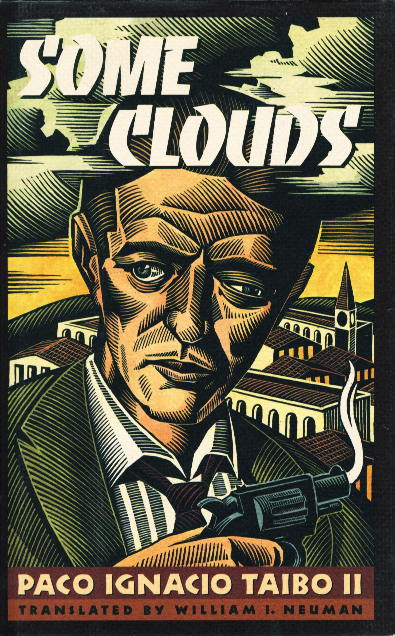
The symbolic clouds are puffy white and filled with promise as the story opens in a tropical paradise where independent detective Hector, now with a limp and minus an eye, is recharging after his wounds suffered in “No Easy Thing.” His retreat is cut short, and he re-enters a crime world far beyond his ability. By the end of this book, the clouds are dark and foreboding over the evil in Mexico City — Hector will describe them as “clouds of shit.”

In a masterful and imaginative mood, Taibo writes himself into this book as a writer. The character is named Paco Ignacio. The chapter in which Hector and Paco meet is like an interview between the author and his protagonist. Ignacio later plays a surprisingly important role in the story and becomes a deux ex machina figure.

Hector’s sister Elisa reappears from the previous book and talks Hector into looking into a friend’s murder case. She later regrets that she led her brother into such danger. We get the feeling at the end (it is only about 130 pages, perfect for a Hector novel) that our hero is not out of the woods. He won’t flee the country and hide however. He will remain in Mexico and face even more trouble in the next novel, “No Happy Ending.”

Each of Taibo’s Hector Belascoaran novels can stand on its own. Yet without reading them collectively and in sequence, the reader may be unaware of Hector’s past, and thereby miss some nuances. They’re also likely to miss how the next book picks up a thread or mood and continues it.

Eggers’ “A Hologram for the King”

(originally posted August 10, 2012 and updated April 29, 2016) – The movie version is out, a sleek ninety-minutes featuring Tom Hanks and some stunning photography from the fictional and troubled megaplex being built by the Red Sea, and from a homogenized Jeddah hotel (where the concierge repeatedly recites “Welcome to the Hyatt”in an Arab accent). There is a scene with some great footage shot in Mecca, where Alan Clay (Hanks) nervously hides in the car as a non-Moslem.

It’s an important movie, a tale of love and redemption that informs us about international relations, specifically with the Arab world. In these times perhaps some will find it increases understanding and peels away blind hate.

Screen Shot 2016-05-05 at 11.02.01 PMIt’s also a take on how it can be sometimes to work in IT. You get sent on a boondoggle, the conditions suck, the network is down, you’re hungry, and no one pays attention to you unless you complain enough or do something outside the rules (like Alan sneaking upstairs without a badge).

In the novel, Eggers’ writing style is clean and direct, similar to the clipped style he used in “Zeitoun.” The book’s print job has illogical spacing. In some instances a gap is put between sentences obviously belonging to the same paragraph. Without the random spacing, and with some merciful reduction of a few scenes here and there, this thing could be close to novella land.

The story moves well, conventionally, and slows down in the middle. It is loaded with humor: the character Yousef is an instant hit, Westernized and corrupted by two cultures. The novel gives a rare look inside the unknown world of the UAE.  It’s a dual world, orderly on the surface, yet disordered on the underside. The work ethic is amorphous. Imports do much of it (“We don’t have unions. We have Fillpinos”). The orgiastic scene at the Danish embassy pretty well sums up the conflicting “moral guidelines” of compound residents vs. citizens.

The protagonist (Alan Clay) suffers a frustrating impasse inside the King’s new business complex, as he and his IT team wait for a chance to make their big pitch to sell the Arabs a holographic teleconferencing product. Meanwhile they’re stuck in a tent, largely ignored, without food and without wi-fi.  During this seemingly endless delay, Alan begins to fall apart. We are privy to flashback after flashback of guilt, shame, and failure.

He’s not a happy guy. And neither are we, suffering along with him. Along the way, we are reminded of the disembowelment of our economy by handing over all our work to cheap labor outside the country. There is a strong section about PPG Glass losing the new Freedom Tower contract to China, who manages to get the work Alan and his crew were after, too. Eggers manages to fit this into the story without making it shout editorial interruption.

Alan’s history of failure with the dying American bike company, Schwinn, is put in contrast to his new dreams as an IT salesman who helps wire the New Arabia. So we have mechanical vs. electronic, the tangible vs. ethereal.

Alan can’t seem to do much right. Two seductive ladies fall for him (we don’t know why), and he can’t handle that either. Can’t perform. One of them is a doctor who surgically excavates the cyst on his spine. Little goes right for them. As she eventually says, “it’s all very sad.”

At the end where we are dropped off, it appears as if finagling a job with the King’s “start-up” business will be his last chance saloon. His last chance to build something to save himself. He’s a man without a country. With a hole in his back.

The movie, however, has things end on a happier note.
“Walter Benjamin at the Dairy Queen”, a McMurtry Memoir

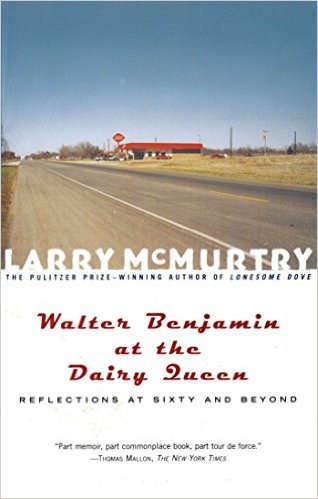
larryMcM-Dairy QLarry McMurtry presents a mixed bag of topics here, essays and personal accounts related to his love of books and writing. He uses a cowboy metaphor, stating his life-work is to corral and tame words and drive them forward to a conclusion. Books are his wide open range where he has spent a lifetime roaming.

He is certainly qualified to talk cowboy, having been one in his youth when he grew up on a ranch in the northern plains of Texas, in Archer City. It’s a real place and also a fictionalized place where movies were shot based on his novels, like “The Last Picture Show” and “Texasville.”

Of more academic substance, McMurtry gives a compelling history of the Texas plains where his family settled and ranched in pioneer days and beyond. It’s also a world he wanted to escape from, going off to urban centers where the supply of books is as abundant as thinking and diversity. So he forsook his father in following a life as rancher and chose to be a bookworm and a novelist. Eventually he came back and settled.

McMurtry validates his subtitle “reflections at sixty and beyond.” He at times is crotchety and nostalgic over times and customs long since lost. It’s a good read, more complex than it first appears. Some patience is required when he wanders off on side roads. One of the better side roads is his account of heart surgery – how surgery and deep anesthesia can change a person. I know several people, including myself, who will vouch for this….something is lost in that suspended time, and its recovery is doubtful. Larry McMurtry fought back to regain his abilities after surgery when he was unable to read. His eventual long dive into the works of Proust and Woolfe reinvigorated the writer in him, a thankful turn for him and all of us who love his writing.

“Lonesome Dove” Revisited

(The book is entertaining. You can read it like Tolstoy – in parts. A brief update to previous post)

lonesomedove

McMurtry’s writing in this one is often like rodeo-talk mixed with the campy voice of “Dodge Ram tough.” Events can sometimes be trifling and sometimes sublime. When the author shifts to events of more substance the writing comes forward with an accomplished ease.

The book’s ending soars above the rest. The Montana chapters and Woodrow Call’s return-to-Texas chapters have their own tone and relentless pace. The writing is clear and unobtrusive and therefore perfect for the action.

McMurtry’s general readership may not know his creative writing credentials. He took his  degree in Texas then joined a highly talented class of writers at Stanford University back in the Sixties, including Robert Stone and Ken Kesey. Frank O’Connor was one of his teachers.

McMurtry gives us honest prose using the omniscient voice of a skilled novelist. There is no short-changing, plenty of patience. In such a lengthy book, enormous writing energy is required to create scene after scene, weaving the motives and desires of characters, making them vivid, and placing them in an action-packed milieu that we can see and experience. Larry McMurty is a treasure in American fiction.

“Why Did I Ever” by Mary Robison

wdieAs if a traditional narrative novel had been mined, and material of value retained and all non-essentials ejected. The remaining ore was enhanced, polished and modularized, then shuffled into a sequence. Each part of the 500+parts has its own impact, its own exhibit or event or revelation.
It makes for disarming reading at first, then one gets into the mood of the narrator, a wry-humored woman teetering on the edge. Our narrator/heroine negotiates a family crisis, drugs, promiscuity, and ADD, and more than a fair share of lousy men in her life (who she relentlessly disses). Much of the comedy derives from her shakey job writing an insipid screenplay, working for an impossible boss in a movie industry for “stupid people.”

I admire and enjoy Mary Robison’s writing (cf. my review of Subtraction). She’s cut her own path in prose. She has the rare combination I like: a poet’s command of words and a cynic’s keen eye directed on America. A Univ. Southern Mississippi and U of H product (and among other places JHU as well), she has been writing and teaching since the early 80s. I wonder if I may have met her in my Houston days, maybe at Rice when Donald Barthelme did a visit-lecture there, and many of us back then hung out in Chaucer’s basement bar inside the old Plaza Hotel.

FWIW, I recommend this book.

Last of the Hector Series – Paco Taibo

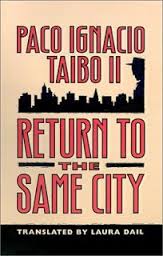
rtscThe translator Laura Dail must know her verb conjugations well. That’s extra important in a book written with a Spanish ojalá premise: if only detective Hector Shayne Belascoaran hadn’t died in the previous book. And you may believe the story that’s about to unfold, even to the climax when mariachi bands are employed as frontline troops.

Taibo brings Hector back to Mexico City for one more show, teasing with us about his right to create character immortality. We readers move up another notch in the suspension of disbelief scale, and we do so gladly because we are aficionados.

In many parts of the book the story is related in a variant of subjunctive mode with what if’s, and it would be nice that’s, and it could have happened like this’s. Owing to a good translation job and the brilliance of Taibo as a writer, the narrative is well-presented with a mix of voices from the humorous author and beleaguered heroic Hector. We buy in and feel assured of entertainment with plenty of human truths added.

During the series we sense that Paco and his character are one and the same soul.

This is likely it for one-eyed Hector and his pony-tail girlfriend. That’s okay, we can go back and re-read and enjoy the five other ones (plus there’s the untranslated “Días de Combate” to delve into).

A.E. Hotchner’s “Hemingway in Love”

9781250077486By way of contrast Hotchner’s 1970s biography “Papa” is a great read, as close a look as we can get to Hemingway the man. It’s a good book for two reasons: one, Hotchner is a terrific writer, concise and communicative without being fancy; and two, he and Papa were truly good friends. The candor and respect shown between author and subject creates an eager reader interest and provides veracity to the accounts. Unlike other bio’s I’ve read, I never felt I was getting any bogus or skewed information in “Papa.”

This new one (dated October 20, 2015) was also produced by Hotchner, who’s now in his 90s.  Most all of the Paris players and the last wife are gone. Hotch admits in his intro that he waited in order to not step on any toes, or risk hurting Mary Hemingway’s feelings.  We see Hemingway as a changed person, closer to mortality after his two near-death Africa airplane crashes. Often he is drinking wine in a series of hotel room meetings with his pal Hotch. These were occasions when Papa was either in ostensibly high spirits or he was blue, expressing regret and spilling over with irony and self-effacement.

As good as Hotchner’s writing remains – and despite an unflagging interest and admiration of Hemingway and his circle – I don’t have the same sense of complete trust with this little book. It’s not a matter of doubt about the authenticity of the information, most of which is already known, or the personal portrayals of Hemingway.

Instead it’s a matter of how Hemingway’s dialog is captured in the text. There’s a license to fudge in a memoir, but long sections of Papa’s conversations sound too pat, too prosaic and laden with facts. The author has Papa describe events or people he knew and books they wrote with Wikipedian detail. Not so sure I buy the Midgetape recordings claim.

Lauren Groff’s “Fates and Furies”

grofEnter knowing the entire universe is about Lotto and Mathilde.

The novel is an overwrought love story presented to us in a most literate and poetic way. It rolls out [twice] the truths and deceptions of a complex relationship between two exceptionally strong personalities. The his and her views are revealed under the watchful microscopic eye of the knowing author, the voyeuristic reader, and some snoopy secondary characters as well (e.g. Antoinette, Chollie, Rachel, and old ESP Bette).

Among the appositional statements the author throws into the mix, one of the most interesting appears when Shakespeare’s Volumnia is used as a point of comparison. Volumnia is the bad-ass mother figure in Coriolanus, who controls her son and rants obsessively, guarding him like a lover (her likeness is Antoinette). Coriolanus is maybe the most down and dirty play the Bard ever produced.

I think it’s safe to say Groff’s novel has more than its share of down and dirty: including cruel mothers, pandering perverts, drunk abusers, sleaze bags, con artists, dangerous neurotics, and lots of porn. Plus deceit, extortion, suicide, self-sterilization, betrayal, and vengeance.

Groff writes in language that is powerful and orchestrated with her content. Her imagery is raw and fresh, often hypnotic. Too often the aesthetic is dumbed down with a sudden sex act. The carnal imagery can go too far (or linger in a frat room somewhere) with lingo like, “and he shucked her right there.” When that happens, the narrative trance is interrupted.

Groff can do the atmospheric magic. She offers a fine portayal of caring artists and creativity in the colony-retreat section. The trap is set. Against idyllic venues on the beach and in the countryside or in the Big City and even Paris, she sets down a chilling collection of conniving, cold-hearted types fucking and vomiting and bickering their way through the pedestrian world. The characters wheel about. Back and forth we go: gifts and denials, triumphs and disappointments, comedy and tragedy.

Smelling the worst is the aroma of extortion.

In the long run, beauty and light edges out sordid darkness. The ending is sad and not as tidy as it could be. It meanders too much in time. It tries to offer redemption that seems too late. The dog named God is lost and then found. Conclusions are delivered before we can arrive at them.

As Orwell reminds us, a literary novel brings with it a wave of anarchy, and Groff is not afraid to shake things up, reach for the moon and take chances.

Paco Taibo’s “No Happy Ending”

nheThe title itself is the spoiler alert. Our hero is in deep trouble with the brutal paramilitary gang, the Halcones in Mexico City.

Taibo uses a tidy 12-chapter mystery format in this one. Other than a single chapter dedicated to the backstories of each of Hector’s office mates (for entertainment purposes, we suppose, not storyline), hardly a single word is wasted. Mexico City is laid out before us in gritty detail. It’s shown as a city beyond order and hope, held together by the remaining good-natured fabric of most of its natives. It’s a land of sugary soda pops, dangerous streets, venal policemen, gangsters, whores, and sometimes humorous and endearing characters, like the office crew and Hector’s elusive love interest, the girl with the pony tail.

Since authors can do such things, Taibo brings his hero back by popular demand in a subsequent novel “Return to the Same City,” subject of a future book report.

“An Easy Thing” by Paco Taibo II

paco2It’s the first chronologically in the English-translated series of Hector Belascoaran Shayne detective novels. The Mexican detective is introduced and developed.

The other – the real first book, is “Días de Combate” which Taibo published for Spanish-speaking readers only. I bought a copy and will give it my best shot translating/reading and reporting on it this winter.

As any review out there will tell you about “Easy Thing” (there is no article una in the Spanish title), the book’s made up of three cases that Hector has taken on at once. As he madly juggles the various events, we learn the most about him in the interim scenes when he’s with family, lovers, or his eclectic office mates (a sewer engineer, an upholsterer and a plumber). As in many American hardboiled crime stories, we are more entertained by the hero himself and his interplay and commentary on the world around him than by the actual plotlines.

Similar to his later novel “Frontera Dreams” (review), Taibo gives us realistic observations about the condition of Mexico, its inherent corruption, and the people’s low-key angst. “An Easy Thing” is longer than most Taibo novels and doesn’t exhibit the same kind of streamlined potency that “Frontera Dreams” has. But the gems within the story are well worth slogging through the most tedious of the three cases, the one about factory union murders. The other two cases, one about a porn star and her daughter involved in extortion, and the other a search to see if Mexican hero Emiliano Zapata is still alive, are less political and more entertaining.

Kerouac’s “On the Road” – the Mexico Trip

*an earlier post described the recent movie adaptation road1

Like any great novel, On the Road has classic sections that read fresh and even more powerful when seen again years later. The most re-readable section of On the Road includes Parts 4 and 5, essentially the novel’s last hundred pages. This is by and large the Mexico trip, which can stand alone on its own raw energy.

Here you find Kerouac on a high wire writing super prose, tightly packaged in a limited timeframe. The episode exceeds phantasmagoria and becomes mythic. Characters loom larger than life within the land of ancient Toltecs. Dean Moriarty on the mountain takes on godlike characteristics. The Mexico account delivers the conclusive impressions of all the gang’s journeys. Their experiences have now peaked and they have pushed the envelope as far as they can. They then test their mortality and move close to the edge, near implosion, blindly expecting things to be resolved on their own accord. And, followed by some angels, they are. Mexico City, which they see as a sort of a Bohemian nirvana, quietly becomes the last stop. It’s the last Sal and Dean journey.

The romantic innocence that marked their earlier trips has gone, and they are in dire straits. They part ways, each suffering their own variety of illness (Dean’s is delusional, Sal’s is mortal). Restless Dean leaves, and Sal feels abandoned. Even back in NYC their bond never mends.

Within this last section, Kerouac artfully makes the symphonic tie-in’s with vital themes and major percussions heard throughout the preceding pages of his story. There is a completeness achieved, beginning with the moment the travelers become one with the Mexico earth and its dirt and insects. Then again when Sal hallucinates the end-game’s apocalyptic white horse. Dean the omni-visionary and perpetrator of convenient truths says he saw it too. Kerouac makes us see it as well.

James Lee Burke: “Tin Roof Blowdown”

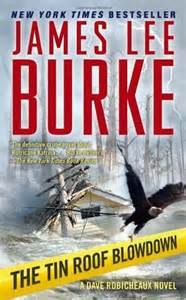
burkeThere’s hard realism in these pages about the social devastation caused by hurricane Katrina. Maybe it’s as frank and true and graphic as you’ll find anywhere. You’ll read much about the disaster early in the book. Street-level. Then as pages go by, the more particular story tends to float and slog along with the murky waters of the flood. There is only so much one can say about hell and its parallels on earth before melodrama takes hold. Around the chaos of Katrina’s aftermath, Burke weaves a bad-guys-are-really,really-bad adventure. The pair of good guys Dave Robicheaux and his pal Clete Purcell strive to make things right. The storyline has its share of sudden shocks, twists and pitfalls, but I was wishing for the less-gloomy violence and pathos found in his other novels.

The narrative voice jumps from first person Dave to omniscient and back. It’s something crime writers often do, and they usually pull it off (to some extent) without any of their readers noticing. In this case, it may be overdone. I was prone to lose the narrative connection, that familiarity I had on page one when Dave talked about his time in Vietnam and its horrors. Burke’s POV “author” is conveniently all over the place. When we return to our man Dave, all the god-like narration in-between seems odd.

The New Orleans storm account (like the event and the nation’s reactions) is heavily laden with underlying questions of racism. Burke’s writing rides the razor’s edge between sympathy (for the flood victims) and loathing (for those who capitalized on the scene via criminal acts). There are some interesting factoids (and euphemistic epithets) thrown forth. For example: in the moments of urban rioting, there are two businesses that are always spared and not burned or looted (by the “Snoop Dog fans”)- funeral homes and the offices of bail bondsmen. Burke does not intellectualize nor direct this into a statement novel. There is a hint, but no mention of the “disaster capitalism” that Naomi Klein suggested as an intentioned by-product of Katrina. One thing for sure… lots of guns are everywhere, and that seems okay with everyone. In that sense I found the story angle a bit Republican in flavor, and it made me want to put the book down or at best hurry through to the end.

The Robicheaux books are written to be simple and very personal (with the hero’s touching family scenes, etc.). The texts have a salty Gulf Coast flavor, not unlike David Lindsey’s Houston detective books. Difference is, the hero of Lindsey’s series, detective Stuart Haydon, drives a Jaguar and has refined West University sensibilities. Dave R is simple and down-home. Whether in New Orleans or New Iberia, he’s an enlightened blue-collar Cajun type. The story is what it is – a fiction writer’s vision. But the account — the factual witnessing of the atrocious and tragic events during and after Katrina, that’s really what sells the book.

I give Burke a lot of credit for telling us about it without being unfair or sensationally biased (as most of the reporting networks were). Whatever made-up story Burke put around it was to me immaterial. Far as I’m concerned, Dave Eggers successfully cornered that aspect of things in his Katrina novel, “Zeitoun.”