booknotes

Books on Writing (1) – The Wheat book

So the editor and publisher chose an unfortunate title: “How to Write Killer Fiction.” There are sections in this book that are much more sophisticated than that. And in fact, they contain material that is subtle and artful and difficult to find anywhere else. Not without a lot of wading anyway. Carolyn Wheat presents things to us in a straightforward way.

It’s not entirely a book about how to write murder mysteries and suspense novels. In fact, I skipped over much of the first part about mysteries and was no worse for it. It’s really a book about how to create suspense and build scenes and story patterns in any genre. To help us out, she first provides a succinct list of novel categories and types, de-mystifying the book market genres and showing us which are the most popular at the airport bookstand.It is up to us to apply her information to the type of book we are writing.

Wheat’s discussion on how to use the outcome pivot devices of “yes, but…” and “no, and furthermore…” are worth the price of admission.  There is lots of advice about action arcs and reversals and tricks of the trade. Examples are used that require some inference. I am not sure if a beginning writer can catch all the subtleties and complexities. The book has a good share of writing nuggets, some so profoundly basic and true that we can tend to skip by them. On the first go-through anyway. This is a book worth reading more than twice and can kill your highlighter. I keep my copy  with the other handy writing reference favorites (to be reviewed as well in upcoming posts).

Wheat doesn’t overload us with inspirational and cutesy writing fluff, like so many of the other writing books out there. Some of the material, like the last section of general writing advice, is ordinary, but her advice on creating suspenseful scenes, employing outcome tricks, and identifying genres is about as rare and useful as you can ever find. But we have to think and apply.  It’s not a hand-holding type of writing guide.
The Secret Miracle

It’s a collection of insights and habits as described by a mixed group of successfully published fiction writers.

It’s okay, but I’ll probably put it in the stacks for donation.

It reads like everyone wrote their answers to the topic-driven Q&A at home and sent in their answers on a telecommute basis.  There’s no evident interaction or the feeling of listening to a panel at a seminar.  The moderator becomes an editor and is sometimes inconsistent, giving us not enough in-depth discussion on some topics and way too much chat on others. In some cases, when things are just warming up and getting interesting, he pulls the plug. Maybe the mailed-in supply of material ended too soon.

That aside, there are lots of interesting tidbits for writers to consider and measure their process against.  The topics are given in a TOC, which is pretty generalized. So in order to relocate something for reference, it’s probably necessary to have read all of Joshua Foer’s memory book (see May 12).  Thats okay. The book is okay even if you open a page and go fishing.

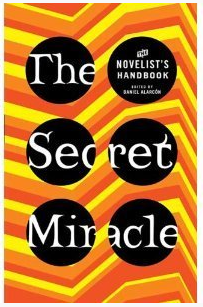
The title refers to a Borges story.  It sounds like a Sunday-school play. I get the connotation of it being “inspirational,” or maybe that was an accident, and no one could come up with a better title. The cover’s Halloween colors dilute the air of holiness.

I didn’t know who many of these authors are, and tended to skip and carefully read responses from the bigger names: Chabon, Egan, Goldman, those. I hope all the writers got paid well to talk shop and put their necks out there in print. Their secrets about the supposed miracle aren’t secrets anymore.

Joan Didion’s “The Last Thing He Wanted”

The novel’s storyline of international intrigue doesn’t interest me nearly as much as the power of the writing itself. I am hooked immediately by the narrative voice and Didon’s skillful style.  It looks easy but is not.  The parade of paragraphs is far from conventional. It is successfully non-sentimental, as we are led to believe the author prefers things. But I don’t find it cold. It’s unique, maybe hip, and at times choppy and not always linear. Didion has the artfulness to pull it off and make the prose sound superb. If it sounds at times disjointed and loopy then it fits the world it describes.

Some of us really like opening chapters that sound notes or chords of the music that will run through the rest of the novel ahead. I’m well set up and tuned in, after reading the concise compilation of mood and circumstance presented in C1. It’s a poem and a prelude and a functional opener in only 500 words or so. It’s something a writer can study and learn from.

Didion is probably more well known for her non-fiction and essays. Of the ones I’ve read, “Miami” is my favorite, for all the light the author provides on the history of Cuba’s association with the city. The White Album is on my list to do. I’ve read one or two other Didion novels, and solely for its unique style and perfect language, “The Last Thing” is the best I’ve experienced so far.

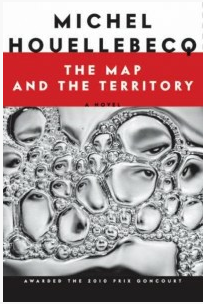
Houellebecq’s “Map and the Territory”

On the basic level this is the story of Jed Martin’s artistic phases, his romances, his successes and failures, and his relationship with his father. This thread persists to the end of the book, even though part 3 strays and becomes its own self-standing mystery story.

Houellebecq cleverly includes himself as a character, a bit part at first and later more active and prominent. He is hired by Jed Martin to write a descriptive chronology of his works. This device gives the author an added dimension to his ability to present all things Martin. And many things Houellebecq (the writer’s home, his habits, his diet, and eventually the stench of his own murdered body).

My favorite thing in the novel (which has some eye-opening sections about art and the gallery business and a particularly terrific set of discussions about William Morris and the Pre-Raphaelites) is the interaction between Jed and his father. Houellebecq can be hard-shelled, sometimes aloof, but he got the son and dying father part down pat.

My least favorite thing (and this is at the ‘Picky’ measure line in the jigger) is the principle character’s name. Jed Martin sounds like a hillbilly name, and even if younger readers who never watched Paw and Granny don’t get that, well, how about  the fact that Jed sounds too much like Jeb.

Other items of note:  the women interests, Genivieve and Olga, are no mere stick figures but instead real and memorable. The more involved and/or subtle descriptions of France and the French way of life are likely best appreciated by those who know France, and since I don’t, I skated through much of that stuff. Jed’s agents and curator characters were more auxiliary than alive, and in keeping with the allegorical patterns in the novel, that fits.  It’s the art and the work which are real and of the heart, while the presentations and sales are secondary.  Finally, another interesting twist is that Jed Martin is the antithesis of the financially failed artist we’re usually stuck with in stories. Everything he produces turns to gold; he becomes immensely wealthy and in high demand.

His shorter and more mundane novel “Whatever” remains my favorite. That one portrays a bourgeois world of business writers and software folks that I can identify with more readily.  “Map and Territory” is on a far grander scale, dealing in a world of  wealth and endeavors far beyond the sphere of us ordinary grubs.  It is nevertheless a very good novel and not a pretentious one. It took me a while to read it because each paragraph has weight. Some parts were dead-on witty and perceptive. The book has a more complicated allegorical level, which is worth further contemplation. One day.

Joshua Foer’s “Moonwalking with Einstein”

The location and title of every book in my palatial office is fixed in my memory. Sometimes I give them a cutesy nonsensical associative phrase to help me remember. Like, Norman Mailer’s hardback is rubbing against Amy Hempel’s front matter.

Sure I do.  Not.

I forgot to say that this book about memory training is not in my collection. I had the good sense to check it out of the library rather than spring for it on Amazon. And remembered to take it back nine days before it was due.

Evelyn Waugh’s “Vile Bodies”

This is an odd thing to be reading. It’s a 1930 British novel discovered in a roundabout way.  I liked Alduos Huxley’s novel Chrome Yellow and searched Amazon for something similar: an early century comedy of manners, or a compact novel that presents sort of a claustrophobically attached circle of people. Preferably portrayed with and without mercy. A style that bares their naked motives on stage, like Shakespeare would, or Dickens.

It’s interesting how Waugh makes characters and scenes so alive with so little effort. There is not much accompanying narrative to describe who they are or where they are; just enough to be efficient  The story moves via dialog, often as sharp as a razor. Waugh also has a knack for profiling characters by their names (Miss Runcible, Mr. Outrage, Fanny Throbbing). A few pages in and I’m on the boat with them, seasick and singing hymns for the benefit of Mrs. Ape.

The Angels (named after Virtues) stay aft on the ship and in second class on the train. We’ll have to see what becomes of them. Waugh became a converted Catholic around the time this book came out. He was 27.   Guilt?  It didn’t stop him from writing some (reportedly) even more scathing books afterwards.

Jennifer Egan’s “Emerald City” (with…pause…Bernadette)

Egan’s short story writing led to the construction of “Goon Squad.” That adds interest to reading this collection of her earlier work.

The nine stories keep us engaged, provide excellent writing with precision and imagery, and then close with something of thematic value to consider when we’re done. What more could you ask?

For example…the first two are risky and dark, presented with skillful characterization. The first examines a traveler in China with a male crush trying to conceal it from his family. The story walks the tightrope between safe and creepy.  The second is about two teenage Catholic girls with a sexual attraction, the adored one being more lost than the other – she’s a cutter. Being enamored leads the good one to go way off course. We worry about them both and go back through the pages looking for a clue to what will become of them.  This makes me think of “Goon Squad,” where Egan has the open landscape of a novel and takes advantage of it to provide a summary, in media res, of where characters will arrive in the future.

The title story “Emerald City” borrows from the illusory Land of Oz with its supposed shining glory that requires visitors to wear sunglasses. In that story, the glasses themselves make the city look artificially green. Otherwise, as the Wizard knows, the city is not glossed with gems but is ordinary. The story is about the lure and superficiality of fashion photography. That’s a big topic and Egan offers us an intimate and informative picture of the business and its players within fifteen pages. Vesuvi the big name photographer is the Wizard figure, cloaked and powerful. The two lead characters, Rory the photo assistant who looks like a SoCal beach boy but is from Chicago, and his girlfriend Stacey the quite-not-good-enough model, are like visitors to Oz. They aren’t exactly dazzled by the Emerald City.  They don’t fit as well as the bratty Russian model (closest thing to a witch here) who brags about her status and percs. Rory and Stacey’s  ambivalence about staying in New York City is the story’s core element. In a way Rory and Stacey are heroic; they are not easily taken in by its seductive lure.  Even Vesuvi demonstrates, with great guffaws, that NYC is not the whole wide world.

Many more. “The Stylist” with Bernadette’s toes in the sand is one of the best ones. Another is “Spain in Winter” showing a darker side of bright Granada. And the Catherine Black character (in “Puerto Vallarta”) – sexiness on a stick and morally flawed? We all knew one.

But … (experience Jennifer’s snapshots and tricksters of time … for yourself).

Dana Spiotta’s “Stone Arabia”

Report in progress:

  • 1st night’s reading derailed by the pages and pages of italicized stuff.
  • next day, things got a little better, typeset and story-wise, but noticed the narrator overstates most everything, thereby narrowing any chance for the reader to think independently.
  • wondered if the timing wasn’t right to read this book, moody reader thing.
  • the overstating, which I thought might just be a temporary style to induce a breathlessly excited tone for mundane events (full, deep cups of coffee?), doesn’t stop and keeps going and going and going…
  • Skimmed far ahead and read the same thing I read earlier, repeated a different way.  The content’s padded? Maybe there’s a reason but maybe not.

(to be continued after some eyedrops, a beer and two Advils)

  • Back.  Tried again, but… obviously a major conflict in style appreciation. Sorry. I will try to simplify it in five words instead of five hundred: I can’t read this novel.

Julian Barnes’ “The Sense of an Ending”

Principle character and narrator Tony Webster is in his early sixties. The being British part doesn’t get in the way. We can relate. Tony is a mixed bag of deliberations and compulsions – he buys stuff to descale his tea kettle and, in the spirit of older men with little to lose, is eagerly willing to make a fool of himself over women.

Veronica Ford becomes the object of his obsession, which makes us shake our head with pity because she is such a hollow bitch. It is her mother who proves to be the most interesting female character (wish there had been more of her). Tony’s ex-wife Margaret is portrayed as all-knowing and a bit too precious. If they had ever taken that late-post-divorce romantic weekend together, I would have thrown the book down.

The first part of the book has a prep school feel to it, and the second part zips quickly into middle-age.  Barnes via Tony presents endless observations and little theories about life as an aging idle dude. It is the reader’s task to separate the hoodoo from the chaff…for Tony is far from being a reliable narrator. Tony can be astute and pretty damn dense at the same time.

Interesting and detailed depiction of email as a role player in today’s relationships.

Literary grade A, no wasted words, fast and efficient. I read it in two sittings. Not sure how much of it will stick with me as memorable.

Jennifer Egan’s “Visit from the Goon Squad”

Never claimed I could write a book review, but I’m only beginning. This book made me want to write something. I can’t say all the good things that well, but this is some book.

One review points out that the novel ends where it begins. And in between, everyone has changed, including you the reader.  True. Another calls it a “art at its best—a bulwark against the goon,” saying it (the book) “embodies everything at once.” True as well.

There are sections that can make you laugh or stun you with the power of the writing. The ending of the Italy chapter had me in sentimental chills on a sunny day by the pool. A girl captures a setting sun in a circle of wire on her window frame, just as Egan captures us.

When I heard the novel had a Powerpoint chapter, I said No Way. But it’s amazing and somehow a perfect fit. Even so, it’s just an added attraction. The guts of the novel are the intertwined series of narratives delivered by Egan’s cast of characters.

Her prose is dialed in perfectly, images abound, and there is a carefully crafted symmetry of events. Unexpected reading treats abound, much more than the hype over the Powerpoint chapter. One of the late chapters offers a glimpse at our digitized future in which we are all self-promotional in order to get by.

The goons are time and circumstance, thugs of chaos or control who we have to strike a deal with. Egan’s characters have their own ways, and some of them triumph, others fail. Marketing, a theme that permeates the book, is not their end-all solution.

I’m tempted to put aside everything else and read it again. (update: no, I’m ordering Jennifer’s “Emerald City” stories, then “Invisible Circus.”)

Elmore Leonard’s “Valdez is Coming” and “Stick”

Elmore Leonard wrote pretty damn well in 1970 when he put out the Western novel Valdez is Coming. You can see some Hemingway influence in it. His style is clean and unaffected and he makes use of interior monolog to let his characters ponder ethical situations. There are honest and deceptively skilled descriptive scenes that take place in plains and forests and mountains. The action involving Valdez and his love interest borrows straight-faced from Roberto and Maria’s sleeping bag sequence in For Whom the Bell Tolls.

Leonard doesn’t slow us down with transitions and segues. The narrative string presses forward. Both of these books end with satisfaction, yet the endings are wry and abrupt, minimal without violins or fireworks. (the ending in Stick took me by surprise, assisted by the side-effect of reading it on a Kindle that showed the book 80% complete – turned out the last 20% of the kindle file was promotional copy about Leonard’s other books).

His characters are vivid: some evil, some stupid, some sexy, some heroic. There are loyal madams, allied giants, and converts who back the hero. There is vengeance. Some characters reappear and drift between novels.

These are features he has maintained and perfected decades later in his crime novels.

In Stick, Ernest Stickley is a hybrid good guy-bad guy (he also appears in Swag). On the loose in South Florida, he falls among some rich and fast company. There is no real hero, no girl to hold in veneration. It’s a small study in corruption, men and women alike (the women in this one have appetites while the men are into games). Things move at a good clip, and while some have criticized Stick for being plotless, it has enough action and character study to make it top-shelf stuff.