booknotes

Blog-a-rama Review Complete: Rachel Kushner’s “The Flame Throwers”

RK

Posts now re-sorted into chronological order:

April-29-2013

When you get terrific riffs of prose like this from Reno the girl biker narrator…

“At a Mexican restaurant across the road from the motel, I ordered fish, which came whole. I picked around, not sure of the appropriate method, and finally decided to cut off the head. It sat on my plate like a shorn airplane fuselage. In its cavern, instead of menthol-smelling pilots, the dark muck of its former fish mind…”

…and more stuff like…

“ALL VEHICLES WITH LIVESTOCK MUST BE WEIGHED. I passed the weigh station, breezed through third gear and into the midrange of fourth, hitting seventy miles an hour. I could see the jagged peaks of tall mountains, stale summer snow filtered by desert haze to the brownish tone of pantyhose. I was going eighty…”

…you have to realize you’re in the midst of something special.  It’s a novel to bring you out of the fiction reader’s doldrums.  So far, Rachel Kushner’s book is off the charts for being, well, damn good.

Okay. There will be updates to this as I slowly journey through the novel.  As background, I steered clear of  her “Telex from Cuba” when it came out, because of reviews saying it was narrated in several voices, a style some of us don’t prefer.  Now, it’s likely I’ll  go back and read it. Something as powerfully written as “The Flame Throwers” will do an author the ultimate favor: it will fire up readers to buy everything else they have on the market.

May-6-2013

This is a terrific book – I don’t mean otherwise, but the virtuoso performance of the early chapters makes me ask: is a pace like that sustainable? I’ll get to that.

But on a darker note, in relation to thousands of unknown writers far from Kushner’s league who struggle and try desperately to win an agent query (and are limited often to submittal only of chapter 1 or the first several pages ), do these writers have a tendency to try and top-load their first chapter?  Just to try and win attention? Do they leave any mojo for chapter 2 or 10 or 22? Is it no longer sufficient to have a hook and an engaging voice? Does it mean now we also need exquisite writing, top-drawer imagery, a skillfully condensed presentation of the book’s synopsis, and some brand new stunning take on the world, all packed in the very beginning?  Is the result a more literate package or something trending toward gimmickry? Is the tail wagging the dog?

Moving along, I have no concerns about Flame Throwers losing momentum.  The high quality is sustained, one-third through the book where my marker presently sits.  I’m reading a masterful account of a young person’s immersion into a big city’s way of doing things, how people interact as strangers hoping to become friends.  A world where mannerisms mean nothing, only art and substance in this crowd. Some time jogs back to the Red Guard are interspersed, making me glad I read other reviews and expect it. The reader interest factor is much more more ablaze (like the cover’s colors) when we’re right there with Reno as she makes her way in the city scene, from film leader China Girl to…who knows. There’s more of Giddle the pedantic Aunt-type waitress than I want, and if Giddle’s over-grilled,  it may be a thematic device indicating Giddle’s cynicism is something drummed into us and easily embraced yet eventually something to be avoided. Meanwhile, Reno is sandwiched with two male friends of varying radicalism, not that this concerns her too much.  Danger doesn’t exist.  Loneliness exists. She’s young and fearless and willing, whether getting a female-version hand job in the movie theater, or riding her Valera bike into speeds of even higher abandon. It’s all very compelling stuff.

May-16-2013

In an online interview Kushner refers to herself as a “fabulist.” That’s becoming more evident in the middle sections. We get to read the woman-struck-by-meteorite at the kitchen table digression, for one.

Earlier there is an inventive depiction of Valera’s erstwhile friend Lonzi in Sao Paolo, Brazil. The imagery is cinematic, rich with connotations:

“They sat in wicker chairs, he and the men in linen, the woven caning of their chairbacks blooming up behind them like gigantic doodled wings. Nearby, something called an umbrella bird crouched inside an enormous cage, a shiny black thing that kept fanning itself out, menacing and ugly…”

At the same time, Kushner can also put out a striking image of historical verisimilitude:

“Mussolini was hung from the girders of an Esso station in the Piazzale Loreto in Milan. He was next to his lover and a small coterie, all hung upside down …like Parma hams.”

The dinner scene at the Kastles plays relentlessly ahead like a long abstract anthem. We’re brought into it, there at the varnished picnic table raised like some sort of holy pyramid object through the elevator shaft. It seems every little thing has its micro-story at this point. We can empathize with Stanley’s saturation with words as he weeps at the table. The scene relating an audio tape about a couple with an amputee sexual hangup goes on too long, but otherwise the reading locks us in.

One day I’ll return and read parts again. The feeling is much like the one I felt when reading Franzen’s “The Corrections” for the first time.  There are so many good passages of writing to explore and analyze. I had my own image of Amy Hungerford coming to the Kastles’ party and illuminating us with color commentary.

I look forward to completing the book (no, I  do and I don’t) and will report more next time.

May-22-2013

Found a couple of typo’s, kind of surprising in a book of this marketing scale. My mind drifts from the page and I wonder about the smaller font’s effect. I sort of slog and skip through the street radicals section. Along the way my sleepy narrowing eyes widen when I come across one of Kushner’s dandy simile’s. Some comparisons (such as the hair curlers image: “like a tarp over a log pile…the hollow spaces for hope”) remind me of Raymond Chandler’s: original, robust, and well-placed. Meanwhile only Ronnie seems to be dynamic on the page at this point in the novel. The guy purportedly enamored with her, Sancho or Cilantro or whatever his name is, needs to step up to the plate and show us something.  Is this a book with vacuous males? I still wonder about Reno’s deal, too. Who is she?

May-25-2013

Chapter 14 is lengthy and brilliant: all the rich details and imagery and interactions on the Valera family estate in Italy.  Eyes locked on the pages again, not drifting. The matriarch is perfectly portrayed. I dig the old novelist. You can sense something amiss with Talia. Roberto is more real than his brother.

May-29-2013

Cilantro or Sontoro or Sominex, or whatever his name is, got caught with his pants down, as expected.  This gives Reno more impetus to be a grrr-irl and get back to bike riding.

But then Reno is in Rome with a lawn jockey. Dimi has been kidnapped and things are getting dicy and insecure for all. I still wonder what Reno’s  deal is, i.e. what the hell does she really want?

May-31-2013

The end sections are well constructed, story-efficient and in more places than one lyrically sublime. I won’t talk about them beyond that. So this is the last post.

Earlier in chapter 16, maybe it’s the obligatory action climax section. The Red Guard apartment scenes and the dramatic street riot scenes have a reporting sound. There are a few scattered highlights. One is Kushner’s vivid description of the young singer (she’s represented by the girl photo’d on the cover) standing to project her “Callas-like” voice in the midst of chaos.

Things get a bit romance-novelish and breathless (and again towards book’s end) when Reno encounters Gianni again. Then we find out Gianni is banging one of the other girls. Reno can’t hold a guy, it seems, or maybe she’s mistakenly attracted to too many philadering types. Who knows about Italian men – or any damn man – anyway, the substrata message seems to say. Reno has certainly played both sides of the fence and put herself in the midst of the rich bourgeois and the threadbare proletariat, gallery power-brokers and criminal desperados. If nothing else, she has more source material for her art.

Story delivery is story delivery. The main attraction to me for this book is that it’s a terrific display of creative American writing. Style and intelligence behind the prose, a writer coming into their own. If the agents and the market weren’t driven so much by storyline and profit, Rachel Kushner could be our 21st century Proust.  Or maybe our James Joyce.  She’s that good.


Big Reads

Each year, I try to do what I call a Big Read along with the other normal-sized books.  Lately I’ve been trying David Copperfield, which is 900 pages or so but easy reading, compared to most. Giant reads like War and Peace that take years rather than quarters.  There have been others like Melville’s Moby Dick, Joyce’s Ulysses, Bolaño’s 2666, Thomas Wolfe’s massive unedited version of Look Homeward Angel called O Lost.

Each event has had its pains and gains. No secret: there has been wading, hedging, skipping. For example I couldn’t endure the entire list of grisly events presented police-report style in 2666.  I chose to be selective. With Melville, I drifted in and out of sleep with his minutiae, his random straying from narrator Ishmael. Many parts of Ulysses are just too dense, too arcane (though I have since been trying to revisit it, chapter by chapter, as if studying a long and wonderful poem, and acquiring the Gilbert guide helps). Maybe Wolfe’s is the only one I read thoroughly and hung on in amazement, word-for-word.

Reading Franzen’s novel Freedom (in itself a pretty big book and one digested completely) prompted me to go to War and Peace. In the Franzen book one of his characters (Patty Berglund) escapes to a lake house and takes the occasion to finally read War and Peace. Her decision, according to many reviewers, is a significant device within the book (an expression of her need for clarity and a thematic parallel to love triangles), a matter discussed in various erudite reviews and blogs.  Maybe all that’s valid, but bottom line, it’s a matter of her being in the right place under the right conditions and with the luxury of time (freedom?) to tackle it. That’s something we all identify with.

wpAnyway, Volume I of W&P is now behind me. The plan was to stop there for a while and consider the merits of going ahead. Not much deliberation. I’ve even become used to its weight, finding the right spot on my midsection to read it comfortably in bed. So, my bookmark is well into Volume II, where at its end another pit stop will occur. There will be two volumes and six hundred pages more after that.  It’s colossal.

Like the Patty Berglund character said in Franzen’s book, I am surprised how readable W&P is. The book is far better than I ever imagined, so far, and my admiration for Tolstoy as a writer has jumped exponentially.

Two example sections below that I particularly like in Volume I:

“It was nine o’clock in the morning. The fog lay unbroken like a sea down below, but higher up at the village of Schlappanitz where Napoleon stood with his marshals around him, it was quite light. Above him was a clear blue sky, and the sun’s vast orb quivered like a huge hollow, crimson float on the surface of that milky sea of mist. The whole French army, and even Napoleon himself with his staff, were not on the far side of the streams and hollows of Sokolnitz and Schlappanitz beyond which we intended to take up our position and begin the action, but were on this side, so close to our own forces that Napoleon with the naked eye could distinguish a mounted man from one on foot. Napoleon, in the blue cloak which he had worn on his Italian campaign, sat on his small gray Arab horse a little in front of his marshals. He gazed silently at the hills which seemed to rise out of the sea of mist and on which the Russian troops were moving in the distance, and he listened to the sounds of firing in the valley. Not a single muscle of his face- which in those days was still thin- moved. His gleaming eyes were fixed intently on one spot. His predictions were being justified. Part of the Russian force had already descended into the valley…”

– copied from the online Maude translation.

and

“What is it? Am I falling? Are my legs giving way under me?” Prince Andrei thought, and fell on his back. He opened his eyes, hoping to see how the fight between the French and the artillerists ended, and wishing to know whether or not the red-haired artillerist had been killed, whether the cannon had been taken or saved. But he did not see anything. There was nothing over him now except the sky – the lofty sky, not clear, but still immeasurably lofty, with gray clouds slowly creeping across it. “How quiet, calm, and solemn, not at all like when I was running,” thought Prince Andrei, “not like when we were running, shouting, and fighting; not at all like when the Frenchman and the artillerist, with angry and frightened faces, were pulling at the swab – it’s quite different the way the clouds creep across this lofty, infinite sky. How is it I haven’t seen this lofty sky before? And how happy I am that I’ve finally come to know it. Yes! Everything is empty, everything is a deception, except this infinite sky. There is nothing, nothing except that. But there is not even that, there is nothing except silence, tranquility…”

– copied from the 2009 Pevear & Volokhonsky translation, the version I’m reading. It’s good, and sometimes a small crash course in French too.

“Brownsville Stories”

This is a collection by Oscar Casares, an author I ran across when looking for fiction set in the Rio Grande Valley. Also uncovered was an older book, Americo Paredes’  unfinished novel “George Washington Gomez.” So far I’ve yet to finish the novel, which I’ll review here too. I read most of the Casares stories.

The Brownsville fiction is well-crafted, conservative writing. Casares unfolds some nice stories, produced in the tradition of short fiction as influenced by the University of Iowa. He controls the use of Spanish phrases, tactically placing them so they read with sensibility and purpose.

It’s good stuff, but there’s not much dirt under the fingernails. I wanted to learn more about the underbelly of places like Matamoros, Alice TX, Nuevo Progreso, Reynosa, McAllen. I’ve spent some time in the Valley and across the Bridge and get the sense of something stewing underneath the surface. It’s a rough and tumble part of the country, straddling two cultures and unknown subcultures. It’s why I would assume any writing about it would take risks and  have a more investigative aspect or at least some edginess. But the stories strike me as more suburban, on the safe and quaint side.  Some pieces, like the bowling ball story, have the guided familiarity of an American sitcom.

I’m corrupted by Junot Díaz and Roberto Bolaño. Still, I think Casares’ story-writing, solid as it is, could use a dose of hot sauce.

Capote’s “Breakfast at Tiffany’s”

One of the dust jacket blurbs on the Modern Library hardback version came from Norman Mailer who said he wouldn’t change two words of Capote’s novel.  Meaning, obviously, the story is near perfect in every sense. It was no exaggeration. The purity of the writing is like “The Great Gatsby,” a novel in which every word and every sentence rings true and exudes a smart sort of elegance. Old Norman also said “Breakfast” was destined to become a classic, and maybe it has, though the film version tends to come first to people’s minds. If the novel hasn’t been studied enough, it must be because the same sort of stuffy academic moralists who won’t give Holden Caulfield his due won’t give it to Holly Golightly either.

What are the characteristics of this book otherwise?  It’s fresh and feels contemporary. It’s a story of identity, ego, finding one’s niche, and the close relationship between noble aspirations and being a con. Character study par excellence. Both funny and sad in parts. Spot-on descriptions and engaging dialog, and an alluring voice from a sensible and credible narrator. Structurally, we are placed within the walls of Joe Bell’s bar and as readers we can stay right there and  have a martini and learn the whole scoop. The revelations will come to us fast and furious, packed into a brilliant series of packages, all smartly wrapped in thematic weight and expository brevity.

It’s still modern and still hip. I had forgotten what a stylish and resonant story it is. I think it’s an important part of 20th century American fiction. I don’t think the picture’s complete without having read it.

Another Ultra-Brief Book Report: Marilynne Robinson’s “Housekeeping”

A family of women and girls, widowed, abandoned, and otherwise living as outcasts, struggle to exist in a bleak town in the Northwest mountains. Death by water plays a part, as well as migrancy, trains, family ties, subsistence, darkness, clutter, conformity, freedom, and more.

If you meditate on the cover of this book, you’ll get a feel for one of the story’s central images.

This is another monumental piece, larger than its parts, with writing that is brilliant and sublime. It is a close cousin, I think, to McCarthy’s Blood Meridian. Both novels create dark worlds, tragic storylines, and characters of biblical proportions. In depths that scholars can analyze for years. Both novels have astounding lyrical descriptions of landscape and sky. Both cut to the marrow of raw human existence. If there is a simple difference to point out here, it’s that Housekeeping is more accessible and not as savage; readers are more likely to stay with it.

I wondered if I would stay during some slow sections in book middle. I was tested by the family of girls and their insistence on creating their own obstacles. But in the last sections, the pace picks up again once Sylvie makes the supreme mistake of catching the law’s attention. Fighting against the odds, her “housekeeping” compensations don’t make amends, and all that’s left is for her and Ruth to abandon the house.

When they flee, a harrowing scene is described. One relating to the cover. It affected me as much as any Stephen King cellar scene. It’s just one example of the power of Marilynne Robinson’s writing. It may well send me to the store or library to check out her book Gilead.

Frederick Barthelme’s “Elroy Nights”

The narrative paints an immediate picture of over-the-hill Elroy in his sockless Cole-Haan shoes. Not sure if I’m buying the premise of the amicable come-and-go separation from his wife. She seems to take his gross indiscretions too lightly. Elroy is the proverbial horny college teacher who lusts after his female students, despite knowing where the boundaries are. He even tries to reverse time by twenty years and hang out like he is a student. We are glad that the author’s skill in describing the foolishness of this sort of typical professor situation raises it above the levels of normal vulgarity.

The Gulf coast descriptions around Biloxi make that bland area of the country quaint, but I’ m not getting a sense of its seedier and more bombed-out-by-poverty side. Elroy’s life seems most comfy, and his high life is insulated to a campus, his spiffy waterfront condo, and his ultra-tolerant wife’s back porch. And of course, women are at every turn.

The errors and obnoxiousness of Elroy’s unbalanced personal life are described with a sort of smug justification. The evoked distaste is hard to pin down, but it reminds me of the way Tony Soprano’s family is portrayed. Like somehow they’re really nice people. I don’t like Elroy or his family. I don’t feel sympathy toward Elroy or Winter or Victor or Edward Weeks or anyone. Nor do I like Freddie, the PYT Elroy has his rather unbelievable professorial fling with.

Barthelme’s writing is what is special in this book. Parts of it are like distilled Updike, nailing things perfectly but sparing us the flood of supporting minutiae. He writes some terrific passages. From the topical allusions to the balcony urge for a cigarette to the riff on internet usage as company (or solace or merely a way to pass time). The “young girl does old teacher” office blow job scene is pretty good too.

At least one conclusion: despite all the dust jacket praise for this one, I think his novel “Tracer” is a helluva lot better.

Roth’s “The Human Stain”

A novel about a college professor’s identity set in a small Berkshires community in 1998, the year of Monica Lewinsky and the advent of Viagra. That’s how Amy Hungerford opens her discussion of the book in her Yale lecture series on YouTube.  Then the details are enumerated, and she proceeds to make her academic case based on the data, which is the novel itself. It’s her enthusiasm and insight that led me to this book, and to re-visit others she has lectured about (Franny and Zooey, Lolita, Blood Meridian).

This is the first Roth I’ve read in years, and the first one I’ve read that has narrator/author Nathan Zuckerman. I liked Nate right off. I knew I was getting an honest narrator when he admitted to something as private as his own prostate problems and urinary leakage, which manifests in the scene where he dances with Coleman Silk.  His accounts are reliable and without hysteria. My concern was that Nate’s “I” voice vanished early and was gone for almost two hundred pages. There were long, dense sections in third person describing Silk’s college days and romances. Eventually this is made clear near the end: all of the back stories were reported to Nate by a third party. And Zuckerman confirms that this indeed is “the book” Silk asked him to write. Still, and it’s a testament to how well Nate is drawn, I missed him during all those pages.

This is a heavyweight champion writer of the world novel. It’s literature of the highest order. While the topics are contemporary, the storytelling is old-style. We are told and we are give rationales and nuances and then told again. Not once did I yearn for the modern template of action and dialog and limited exposition. In fact, it made the writers workshop commandment “show don’t tell” look sort of superficial and anemic.

The wise character Ernestine makes a brief appearance and bemoans modern people’s lack of patience and resolve, a situation in which quality and substance are lost in the name of expedience. Sounds like prose writing too, in a way.  She says this much better than me and in shorter space. We know that sort of syndrome from what we’ve been “shown” in the story. But there’s nothing wrong – in fact it’s fortifying – when she “tells” us.

In addition to being about desire and identity, the story is filled with choices. The last chapter demonstrates that. There is a choice to be made about confrontation. As Nathan faces Lester we expect either to see a murder or detente.

Another choice, locally. Whether to read other novels in the Zuckerman series, like American Pastoral.  That is the only gray area Roth leaves me with at the end. The rest is black and white.

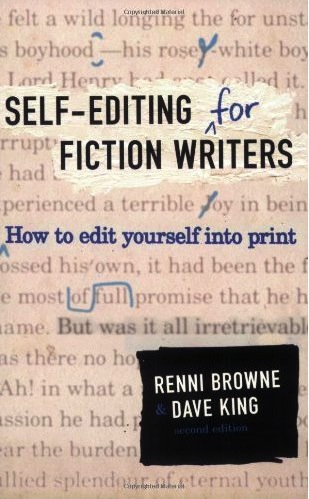
Books on Writing (2) – Self-Editing for Fiction Writers by Browne & King

The subtitle “How to Edit Yourself into Print” provides a warning: today’s book publishing agents look for copy that has been skillfully pre-edited before it gets to them. The old days when house editors lended a hand are gone. More than ever, they say, one is wise to learn to DIY. Or maybe it’s SEY (Self-Edit Yourself).

Handsomely produced and over-abundant in verbiage, the content provides maxims and guidelines. It’s familiar ground.  Nothing about it strikes me as the Go-to book on the SEY process. Instead, most of the topics point back to the initial creative writing process. This more or less says to me, you need to make all these edits because you didn’t write well in the first place, and…so now, let us now discuss how to write.

The thrust of this book lacks clear distinction between fixing a draft (which I had hoped it would, like a field manual I can refer to when I redline) and writing a draft. Come on, guys. Even if we didn’t know what the main POVs are, or how to write dialog, are these really self-editing topics?

What if  all the bugaboos the authors talk about were absent and things were written well in our drafts? What other editing advice do the authors provide? There’s got to be more to editing than fixing show vs. tell passages (pretty shopworn advice, that one is, and you beat it to death. We’re not all screenplay writers out here). And I think most of us know how to break up dialog and we can usually spot a dangling participle. Seems we could get some more pointed writing tricks of the trade. Enlightening us more about technique rather than mechanics.Maybe even something more subjective, like how do we prepare our mindset to view things fresh so we can fix them? How do we make a chapter become impressive reading rather than simply something correct by your rules? In this respect, the teacher-narrators of this book are no match for the guys who both teach and impart wisdom, like Jerome Stern or Sol Stein.

It does have some useful information. The chapter on adding “Sophistication” offers valuable ways to check your prose for amateur mistakes. This section is presented cleanly without as many rambling paragraphs as we suffer in the rest of the chapters, where “do’s and don’ts” are not so easily gleaned. But what’s perfect? Nothing. So maybe their general layout needed the edits of another set of eyes. Self-editing can be blind, after all.

Overall, it misses the mark. It lacks thrust.  It tries to regulate the very nature of free exposition. It begs for an intimate connection. It does not meet the writer as a friend but as a subscriber. It has sort of a chiding schoolmarm tone, like “Why would you want [to do that]?”  Oh, we’re just dumb students, that’s why.  To make us feel even more like geniuses they include writing exercises – with answers!  They’re not exercises, as in normal writing books, they’re little exam questions with no set answers. Well, okay. Maybe this was a workshop course they turned into a book. I suspect its content and delivery has roots in the pedantesque Writers Digest Factory of Experts.

Some of the bold statements the authors make that are misleading or incorrect or queasy:

  • “sketching out your characters for your readers is just plain obtrusive.”
  • “You don’t want to give your readers information.”
  • “engage readers’ emotions, not their intellect” (paraphrasing)
  • “the writer’s voice in a novel generally belongs to a character.”
  • “we see that sort of thing all the time and it’s wrong” (the Royal Condescending We).

NOTE: This post needs to be self-edited. :>0

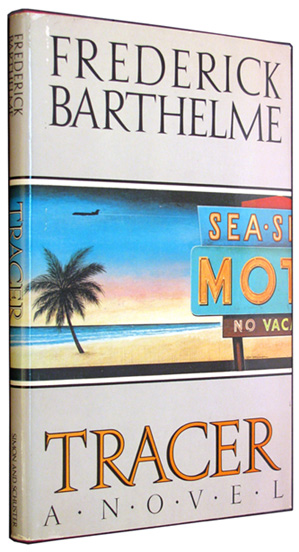
Rick Barthelme’s “Tracer”

Down and out hubbie goes to Ft. Myers on Florida’s west coast, or more specifically to some sort of undeveloped and run-down cracker Gulfcoastal area. There are shitty motels and a pastoral beach where the wind is wild and cows can show up. The community has a few strange souls with dangerous idiosyncrasies: deranged Viet Vet, pancake fetishist, man named Minnie. Dueling divorcee’s can drive cars fast and do stunt tricks on the highway with immunity. The convenience store sells fried chicken breasts plopped on a slice of white bread. We are not sure why the hubbie narrator went there. The divorcing wife shows up for some reason. Hubbie meanwhile is tagging her sister, who runs the Seaside motel and is a lusty well-travelled gal. The kinky sex acts we imagine that transpire are left ambiguous, a nice writing touch and maybe a relief too. Three bottles of wine will of course produce a menage á trois. A wrecked airplane in the woods has been converted into a private retreat with all the trimmings of an efficiency. Characters wander from the shitty motel and go to there like an off-stage waiting area. Rain falls and pings against the fuselage. We think at first the town of Obalisque up the road will be like luxury land, but it’s a dump too. The best of this stuff is pure postmodern imagination, not dissimilar to late brother Donald’s. With an accompanying succinct prose style and a bagful of adept descriptions and imagery, Barthelme produced a terrific book. It’s my favorite of all his stuff.

ps-  A subtitle of this novella could be “Or This is Americana, Sad to Say.”

Grace Metalious’ “Peyton Place”

The clerk at B&N was about my age. Her eyes bulged behind her glasses when I asked if the store had a copy of this book. The computer said it did, so she took me on a walking tour trying to find it.

“I haven’t heard anyone mention that title in forty years.”

I wondered if the clerk’s mom had kept a copy hidden in her nightstand as mine did back in the mid-1950s when this bombshell book came out. Maybe she too snuck a look for the dirty parts.

The clerk didn’t find the book, which I ordered later from Amazon. She was polite and never asked why the hell I would want such a thing.  You know, being a middle-aged man and all.  I’m not sure I had an answer on the ready. I guess I could say that the book stands in time as a period piece and as a breakthrough in women’s freedom to express, and so forth. Or I could have said I’m interested in all fiction and for some reason I’m in the mood to read some soapy pulpy stuff. Presented in an accomplished novelistic way, of course. Yeah. I wanted to see how the best of breed managed it.

Keeping up with the cast of characters made it a slow read at first. The writing is solid and unpretentious, functional. I never found it sappy like a lot of that era’s fiction. Even so, the episodes tend to stretch the obvious and telegraph themselves. I began to skim in the last one-third. The characters perpetrate about every human foible you can think of. The dirty parts are far from dirty anymore; they have a quaint memorableness to them.

The author believed in her novel enough to risk becoming a pariah and eventually she ruined her liver over it. I defer to the more conscientiously written reviews out there and especially to the Vanity Fair piece on Grace Metalious, a pretty interesting read.

Epic Proportions

wandp

Unlike the hackneyed writing sometimes seen in quick-study brochures, it’s discerning, succinct, and a model of organized writing.

Old tech writers (I’m one) can appreciate it.  The text isn’t clogged with dense scholastic theory.  It’s open-aired and practical.  When the reader spots something in the novel itself, the notes are confirming.

At 115 pages and 8 bucks from a second-hand book dealer, mine is the 1967 original assembled by two professors, Doctors Carey & Roberts. Those guys must have spent many a long day and night in offices and taverns figuring out how they would distill the huge book into pony notes.  Marianne Sturman later added short essay-like pieces on theme, structure, characters, etc.

The pieces instruct, in the spirit of the book itself:

“An outstanding feature of Tolstoy’s writing is that his characters are always “becoming” and not just “being.”  Even in static chapters where there is little external action, the characters are changing … Tolstoy can make unusual dramatic material out of essentially undramatic stuff.”

* Follow-up post several days later:  After reading sections of the Cliff’s,  I picked up where I left off. It started with a chapter about a hounds chase at the Roskov estate. Nikolai is in his element and has his veteran dog ready to show how good they are.  He seeks the target away from the pack. Meanwhile hundreds of other dogs and multiple horseback riders go after the  wolves…not foxes, not hares — not a British chase, a Russian one. Rostov has his chance and seems to have triumphed but the wolf eludes him and his hound. The property’s wrangler, the giant Danilo, wraps up the wolf instead.

Stephen King’s “Bag of Bones”

An admission: this is the first King novel I’ve ever read.  It comes highly recommended as being King at his best.

The obvious: the scary factor. King readers know it, but  I had to read and see. It’s all  true:  King can create a spook moment that will have you hearing noises in the house and looking at the night windows wondering if someone is out there.  The “Bones” novel has a scene in which Mike Noonan, protagonist cast as an author of novels, descends the cellar steps in his old (and haunted) lake house in Maine. Each step the terror grows. I had to get out of bed, move around and get the chills out of my spine. Last time I had a similar reaction to a fictional work was when I squirmed in heightened anxiety watching the last scenes of “Blair Witch Project.”

My used hardback version runs over 500 pages. It is a bit messy toward the end. An editor could take a few of the over-extended scenes (like those with Mattie in particular, and the climactic scenes with Devore and at Mattie’s backyard party) and cut them down with no harm. But I wasn’t bothered. I know from reading King’s book “On Writing” that he is a practitioner of writing organically. He puts characters in a scene and a certain situation and lets them go their own way. Let them work it out, let them lead the writer.  It is a mystical place for a writer to be, and I think the results sometimes can tend towards excess.

King’s characters are vivid and skillfully presented. I’m likely to remember all of them, from the evil Rogette to the PYT Mattie.