booknotes

“Subtraction” by Mary Robison

subtrThis is a dialog-heavy novel based on a group of down and out characters who have drifted from the academic Northeast and find themselves miserable in Houston. It was published in 1991. Author Mary Robison has taught English at several universities, including the University of Houston. Her artistic kinship with Rick Barthelme is evident in this book: concise style, irreverent cast, modern pathos storyline, and liberal use of imagery.  Her command of words ascends into realms of poetry. Her images describing rough and tumble Houston (especially to those of us who have lived there) are extraordinary. In the latter part of the book, the snowstorm descriptions in coastal MA are also vivid.  We’re right there with the narrator.

The novel’s most interesting characters are the narrator Paige (the intelligent artist whose progress in life is seized by loyalty to the wayward Raf) and her erstwhile friend Pru (the stripper who uses her perfect body as a machine to survive). None of the characters are admirable. Paige’s husband Raf and  his pal Raymond, both of whom dominate the pages, are almost indistinguishable.Most of the cast are well-educated derelicts with a fixation about getting drunk and getting laid.  Paige’s mom Dottie is a senior citizen stoner. Paige puts up with Raf because of his intense vitality. He’s a Neal Cassady type who draws people in and is moral after all, despite his profligate ways.

We are given a heaping of overheated foul Houston air, low rent squalor, sterile hotels, infidelity, warm beer, a kept woman’s fancy loft, male chauvinism, and Texas-Southern bible-beating right-wing despicableness.

Eventually things cool off as the cast moves back to the coastal Northeast. We go from the indifferent totalitarian to the caring communal.

The effect is like reading Beckett, as suggested in the book:  the vivid imagery might stick around and carry into your dreams at night.

FWIW, I keep thinking…this book struck me as a piece of art that’s ahead of its time. I recommend reading it.

“Anna Karenina” by Tolstoy

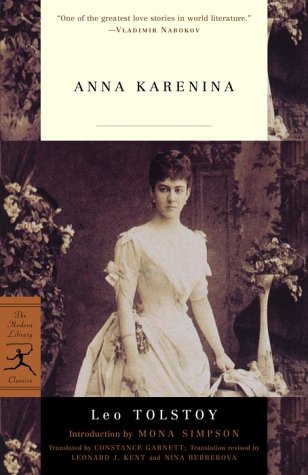
anna-karenina-book-cover-011I gave it up once. This time, taking a patient approach, I read from November and finished by the end of the year. The chapters are short, so you can get a few in during the myriad commercials courtesy of the NFL or on trips to the “library” down the hall. At some points the narrative kept me engaged late in the evenings for hours straight. It’s not a fast read by any means, but it is easier to read than War and Peace (something I may never finish). The chapters clip right along and things drag only at the end, in my opinion, after Anna’s fateful day.

Notes & Observations:

As for format, the Modern Library edition (left) proved a good choice. The translation is by Constance Garnett, certainly not the latest, but it’s pleasant, consistent, and has no tricks forcing the language to be over-contemporary. Any footnotes are conveniently included on the same page where a symbol is placed.

Unlike War and Peace, there’s little difficulty remembering who’s who. The major figures are more distinctly drawn. And more empathetic. Basically, the book jumps back and forth between three sets of lovers:  Stepan and Darya, Levin and Kitty, and Vronosky/Aleksey and Anna.  It offers a a contrast between love with abandon (Anna and Vronosky) and traditional hung-up love (Levin and Kitty) and honor (Aleksey).  Russian love can get so all-absorbing and maddening that it’s fatal to some of the cast. It is a subject Tolstoy knew well and wrote about prolifically.

As one of the commenting authors in the afterword section says, Anna K is a novel of manners, or a novel of society. Plot is secondary to the display of characters and their behavior within the milieu of social class structure. 

It’s an instructive book for writers. Tolstoy was at his best here, and could write equally well in any scene, about hunting, farming, politics, or courting. He can surprise us too, when in the midst of his straight-forward functional narrative he throws in some sort of colorful bonus section.  In War and Peace, I was taken unexpectedly by the frank revelations and level of detail in the chapter in which Pierre joins the Masons.  As an example in Anna K, the author gives us an amusing account of Stepan’s journeys and adventures with a visiting Prince, who he is charged with entertaining. Among their late night adventures they reportedly go to a sex show in which “Russian prowess” is displayed. Meanwhile, the landholder and stifled lover Levin works off his frustration when he goes on a grass-mowing binge, swinging a scythe out there with the serfs for three chapters.

The episodes are short and they go on and on like endless cars attached in a long train. The action is greatest within the characters’ hearts and souls, where changes are always happening. It’s deceptively simple, how we read this and get it. But it’s highly artful and a technical magic act on Tolstoy’s part.

McGuane’s Short Story Book “Gallatin Canyon”

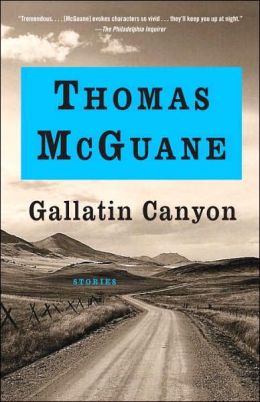
mcguaneFurther evidence that persistent ole fiction writers keep on rolling and can get even better with age.

My notes about some of the ten stories:

“Cowboy” – Familiar tale where a roaming cowpoke gets a job for nothing to prove his mettle, faces resistance, learns to be good at it, and eventually supplants those who hired him (young sumbitch becomes old sumbitch). Narrated in Festus vernacular, funny at times.

“Old Friends” – a visitation format in which a former college pal on the lam (Erik) returns to see an old pal (Briggs). Briggs’ life is solitary and rural, but in good order; Erik’s life is fractured. A distant alumni gossip writer and the pal’s mean-spirited ex-wife are external haranguers who further upset Brigg’s tranquility. Oh, and also the loose gal Marge who Erik brings along, a pickup who can’t resist the degenerate Erik but decides to slap Briggs for being, we suppose, polite. There’s a denouement to all this when Erik’s gig is up. His life and Briggs’ life are forever affected.

“North Woods” – A drug-addicted couple hike the deep woods outside Vancouver on a quest to find an object that they can trade for heroin. It’s the new world, and McGuane offers a great line to the effect: if you can look around in the woods up there and see plywood, you’re still an innocent.

“Zombie” – Grim and gothic, a tale of vengeance out in the sticks. Reminiscent of writing by Flannery O’Connor with creepy characters, some who have weird teeth and others far weirder behaviors.

“Ice” – Coming of age story involving a drum major, a promiscuous teacher, and a boy too far out on the ice trying to find his nerve.

“Gallatin Canyon” – The title story indicates there is no escape from business, traffic, angst, tragedy – even in the remote hills out West.

“mitigating circumstances” by Dawn Corrigan

MGnovelI’ve had the good fortune to read an advance copy of my friend Dawn Corrigan’s debut novel “Mitigating Circumstances,” to be released in January 2014 via Five Star.

Part mystery-part adventure and also humorous travelog of the Florida Panhandle, the novel opens with an engaging scene. The facts and action keep coming. We get to know Gale LaRue pretty quickly and like her as narrator. She’s observant, sardonic, and doesn’t waste words.  She’s got the right mix of personal ingredients, locale, and interesting friends and family that have us already imagining a series.

A skilled fiction writer knows how to use details and make characters particular, and Corrigan gives us that. The profiles of the municipal workers in the home office are spot-on and memorable. We know Karen from her Tevas sandals and the fact that she’d rather take time to eat than try to escape. We can recognize the deep-thinking dude in the office who suggests putting out signs to stop the proliferation of signs. Em’s secret cigarette and call for denial tells us things. All the details paint the canvas: the Whataburger references, the drawling good old boys we can see and hear, the spicy adds Gale makes about underwear and “the girls,” and – terrific stuff – Em and Gale’s use of the names of poets and B-film starlets as replacements for more profane exclamations (e.g., “John Greenleaf Whittier!” or “Sara Michelle Gellar!” instead of “Jesus H. Christ!”). There are lots of references to food as a leveling force. Just as Travis McGee likes his one-inch of Boodles gin on ice, so does Gale LaRue savor her Cukoo Juice smoothies.

Corrigan pushes her story forward in an efficient and suspenseful way. In intervening chapters, the narration switches to third person in order to carry scenes necessary to the plot. It’s a technical balancing act for most writers, yet Corrigan makes the shift in POV almost imperceptible.

What I like most about “Mitigating Circumstances” is the writing itself. The author’s command of the language is original and crisp. And Gale Larue’s delivery is funny.

It’s impressive that Dawn Corrigan can write a debut novel that’s refreshingly free of the self-conscious and cloying prose style we identify as coming from workshop schools. She adheres to Elmore Leonard’s Ten Rules of Writing and leaves out the self-conscious parts that “sound like writing.” Corrigan writes directly and with spirit, take it or leave it.

Italo Calvino’s “The Castle of Crossed Destinies”

RWS_Tarot_19_SunIn this novella a series of tales are delivered by individual storytellers, each of whom reveals a certain display of tarot cards.  Sequentially, each array of cards offers a type of free-association story.  As characters take their turn to present, the indicated actions and events become interwoven. Cards conjoin and overlap. Destinies cross.

Besides the cleverness and intrigue of the fiction, the stories offer those of us interested in the tarot ways to get more familiar with the cards themselves. The group uses the traditional tarot deck in the book’s first half, then a more modern deck in the latter.

Each card is a poem begging for exposition, illustrated with items that tell and have ranging connotations.

The author presents a revealing afterword section describing his usage of the tarot. Everything is on the table in this book. You just have to join in and piece the meanings together.

“I always feel the need to alternate one type of writing with another, completely different, to begin writing again as if I had never written anything before.” – Italo Calvino

Two from McGuane and McCarthy

Novel:  “Ninety-Two in the Shade”

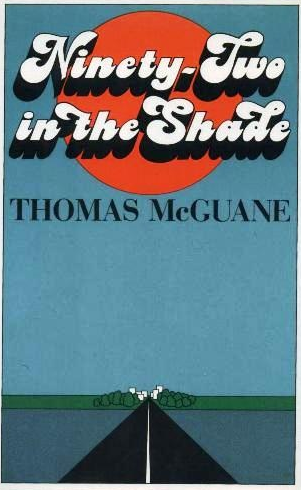
Screen Shot 2013-11-14 at 10.28.21 AM This is an early Seventies book from Thomas McGuane’s Key West days: a yarn with a fair share of conchs, crackers, tourists, and salts. The story’s suspense element involves a skiff war between rival fishermen guides.The boat duel takes on a “High Noon” sort of stubborn seriousness and asks for the reader’s benefit of the doubt.

Otherwise this is McGuane’s canvas of Key West with all its beauty and its warts, and much of the description stands the test of time. The book is comical in most parts, and the writing is rich, even if occasionally it flies too high.

The story features the dissipated Tom Skelton (who lives in a junked fuselage, cf. Barthelme’s re-usage in “Tracer”), Tom’s eccentric father and grandfather, and the violent Nichol Dance as Skelton’s mortal rival. The insatiably willing Miranda, who the author tries to portray as something other than a mere receptacle of sex, doesn’t quite rise to a character beyond that (the froo-froo baking business doesn’t fly, nor does the mention of her being a geography teacher). We get an eclectic mix among all of these characters of both dumb and erudite dialog, woven into both stupid and clever actions.

The author has long since moved to Montana and writes about dysfunctional westerners rather than Florida stoners. His recent story in the New Yorker “Weight Watchers” is a good one – more about trades and occupation than diet.

Movie “The Counselor”

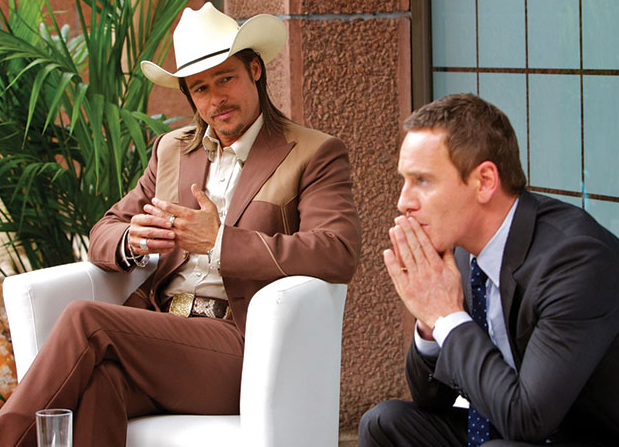
Screen Shot 2013-11-14 at 10.29.33 AMCormac McCarthy skipped the writing a novel part and went straight for the big bucks with a screenplay. Artfully directed by Ridley Scott, the movie’s a balanced story of good and evil, love and lust, and three men’s ruination by greed and by women. The film offers a realistic depiction of life along the US-Mexico border near the hell hole called Ciudad Juarez. Lots of subtleties and complexities are amid the bling and squalor. There’s even a cautionary diamond and a pair of cheetah. Philosophy permeates the dialog in some occasional high-fallutin’ language. The visuals and photographic details are excellent.

Brad Pitt plays a Texan-type to perfection, with an overly eager eye for the gals and a suit that’s too tight. His character gives us the movie’s biggest social commentary line: “It’s all shit.”  In the looming irony department we notice that Michael Fassbender’s  lawyer character is incapable of everything, including being a counselor. In over his head, he is the one who gets all the advice and who seeks help from other abogados (lawyers). Penelope Cruz plays the yummy and vapid little innocente woman, and Cameron Diaz (now of windshield fame) plays the voracious c__, a hunter with everyone in her sights. Cartel captain Javier Bardem plays a likeable, boozy character in this movie instead of his usual role as a murderous figure of holy terror. Except for the opening scene, which was awkward, it’s some good flick.

Frederick Barthelme’s “Law of Averages”

lofaIn these vignettes and short stories of Americana, there’s a fair share of leggy girls who like to go bee-bopping with an older teacher-type dude who often writes in second person present You.  These inquisitive girls from the Mississippi Gulf Coast climb into Your car and ride You around even if You’re driving.

The law of averages says You’ll have marvelous fun with some of them, and some will leave You flat or puzzled.

And for readers, I think that holds true for this collection of stories too.

I don’t know how old these pieces are. His fine novel “Tracer” (also reported on, as well as “Elroy Nights”) still reverberates in my brain and I don’t see the others in the same sort of admiring light. I  read this story collection as an historical perspective, like stuff developed en route to where the author is now, and maybe that was wrong on my part.

I’m one of those readers who groans at first when reading a piece either in present tense and/or in “You” voice. It’s so precious and like 2003-workshoppish.  At least Barthelme, an old pro, can carry it off with skill and dignity.  Few can. We’ve moved on, though – right?

“Telex from Cuba” by Rachel Kushner (summer blog-a-rama)

A-Telex-from-Cuba

July 15, 2013

As advertised, we’ve got multiple voices going on. So far in Part One, there are three:  a young narrator from the sugarcane family (the Stites), an exotic dancer named Rachel K, and a tomboy daughter of the nickel mine family (the Lederers). The only writing in third person is the Rachel K part.  The Stites narrative is mature and eloquent, and the Lederer narrative is puerile.

Amidst the Americanos at work in their bubble communities in segregated areas of late 50s, early 1960s Cuba, the reek of  colonialism and privilege is strong in the air. The capitalist families have a pecking order of maids and chauffeurs. The children have typical bourgeois expectations of security and material things. Except for one of the Stites’ sons, who has gone to the other side. Out in the fields, the hard work of cutting cane is handled by Jamaicans, who along with boatloads of imported Haitians, do the dirty work.

Meanwhile, revolution is advancing in the hills of Cuba. Guerrilla fighters are burning the cane fields and raising hell with capitalism. The imported Americano families are reluctantly freaking out, and the country’s military generals are in denial. The very real Raúl and Fidel Castro are around, as are President Prio and the returning scoundrel Fulgencio Batista, plus cameo mentions of historical American figures like Henry Cabot Lodge.

Kushner, part Cuban-American, built this book on her maternal family’s history plus lots of research and her own vivid imagination as a novelist. She is painting the picture for us in bits and pieces, weaving in facts and keeping up dramatic narratives. So far, her imagery is not as luxuriant as it is in Flame Throwers. But in this novel, she’s a much more interesting storyteller. Parts of the narrative jump in time and between characters, but overall the story pushes forward in a fluid and logical direction. The impacts are less strident, subtler than in Flame Throwers.

Readers are getting a central image from the very start, based on color. The green fields of Cuba are quickly turning red.

July 24, 2013

The cast builds as the eponymous Havana character, dancer-courtesan Rachel K, finds a man of interest, a French political fink. Meanwhile, back on the other end of Cuba, around Nicaro and Preston, more American families and their children are coming into the corporate jungle. The air is rust-colored and foul with the dust of nickel ore. The Allains are countrified and Joad-like, sticking to themselves on a self-sufficient lot next to the factory. The noveaux riche-minded Carringtons and the structured, upper management type Lederers try to live like they are back in the U.S. but they aren’t.

Part One leaves us with the ugly image of a monkey raging inside its cage, in contrast to the one the Lederer girl fabricated as her pet in Cuba and bragged about to her stateside friends.

Part Two opens with a sensational Kushner chapter depicting a dinner party for the managers and the ambassador, held at a dilapidated lodge along a humid river. The American couples drink heavily, especially Mrs Carrington who is an accident waiting to happen. Suffering in the heat, trying to make a social scene out of a rustic get-together, the only ones to keep their cool are Mrs. Mackey and perhaps the ambassador himself, who couldn’t care less that the food is bad or the lodge is a dump. The corporate wives put on quite a show and dominate the extended scene the author has put together for us. (She will do a similar long dinner party scene in The Flame Throwers, see my review). Once again Kushner presents us with an indelible image:

“The Cuban women draped their furs down around their lower backs. Perspiration beaded on their upper lips, caking their makeup and giving their décolleté a particular, reflectant glow. They looked to Tip Carrington as delicious as bowls of ice cream beginning to melt. Something you better lap up quickly, before it puddles.”

Local violence as represented by a cockfight is simmering in the realities of culture warfare. The new character Willy, a local Haitian overachiever, seems the only one with his act together. In the club where she dances, Rachel K is waist-deep in the insurgency, and as Part Two closes, her friend La Maziere predicts a possible violent end to her life.

July 31-Aug 1, 2013

Seeing Hemingway in the novel’s cast of characters, downing daiquiris at La Floridita bar, wasn’t a surprise.  He of course was The celebrity resident in Cuba during the Batista/Castro transition (not long before his departure and eventual suicide in Idaho). The portrayal of the old guy produces mixed reactions. Is the dialog rooted in any sort of hearsay or is it completely made up? Are we to assume that Papa is brainless at this point, jabbering about la pachanga and asking men to dance? Is that an insult, that last one? Or a commentary on how Papa suspects Cubans and their visiting elite are getting soft? It happens twice, from two narrative viewpoints. I’m not convinced Kushner made a great value add to the story.  The depiction of E.H. can be viewed as colorful and comic, or emblematic of the country’s divided sense of values, or as a mini-slam of his writing (“lots of humping and I’s”) – a gratuitous swipe at his legend. Maybe it’s something even deeper in Kushner’s layered scheme, like many things in this book. Take your pick.

Risk-taking is a trait of the novelist, and we get another injection of celebrity-related history with the appearance of Desi Arnaz’ niece, who is a robust young teenage girl who puts the hormone hustle on the Stites boy. He is overpowered by her standing there, swimsuit at her ankles, and can’t close the deal. Gratuitous maybe, but another memorably written vignette in the large canvas of Part 3, which includes entertaining and scandal-ridden events, as well as politically earth-shaking ones. Who ever said the middle parts of a book have to be dull? Kushner is on her game on every single page.

Now Fidel’s rebels are coming out big time, trick or treat. The guerrillas send rats into the cane field with their tails tied with kerosene-soaked torches. Planes drop ping pong ball bombs loaded with phosphor. Other rebels appear in Nipe Bay with their slung carbines to greet the corporate Americans and take hostages. At the rebel camp in the mountains, we follow La Maziere who gets a cringe-worthy nighttime napsack visit by a most unexpected guest (which made me think of Roberto Jordan and Maria, wishing for that old Hemingway romantic innocence in portraying warfare camps). The older Stites boy, Del,  is now a leftist Comandante filled with tactical ideas, and is eager to show his own family who’s boss. An interesting aspect Kushner gives us (obviously she did a lot of research) is how revolutionaries handle such a personal situation, how they can cleverly divert attention from the obvious expectation and get their point across in another, unexpected way.

Cuba’s Rural Guard appears to be impotent against the revolution, sort of unexpectedly stunned like young KC Stites with the naked Arnaz girl.  Denial persists among the Americans, who continue to party and call the revolutionary activities a passing thing.  But as the terrorism escalates, and Batista is duped into bombing Nicaro, the Americans’ fears are growing. We know the inevitable attempt to flee is coming.

At this point in the book Kushner’s multiple narrative POVs are merging, overlapping, and effectively harmonizing. It’s a beautiful exhibit of writing skill that extends until the end.
 

“Frontera Dreams” by Paco Ignacio Taibo II

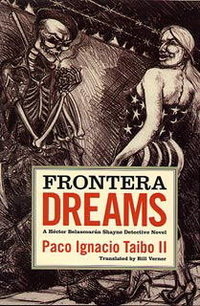
pacoThe cover is hideous and does no favors to the good fiction writing inside.

Paco Taibo has a natural flair for conciseness and a Hunter Thompson sort of edginess to his observations. His storyline takes place along the US-Mexico borderlands and includes many geocultural details. The plot situations and characters provide local insight into one of the most troubled areas in North America. This is all packaged and put forth by an intelligent and witty author who also happens to be a popular activist, journalist, historian and colorful public figure in his own country.

His lead character, a scarred and one-eyed detective, roams west out in Mexicali and returns east along the SW borderlands to Piedras Negras.  He’s looking for an elusive person, a well-drawn femme fatale whose  last name happens to be Smith-Corona, like the typewriter. The detective’s mission is mixed with his affection for her.

The more urban milieu is contemporary: foul and clogged with venal druggy characters and mean Federales. The expansive countryside and desert are bleak and ancient, and allow the heart and soul to roam, as exemplified by the singing voice of Tania Libertad  (the detective hears her Boleros while in a car going across country).

The story is thematically framed by a Chinaman who jumps the border fence with mystical athleticism, then gets sent back.  His leap is repeated like a game, a mockery of the border’s ridiculous attempts at separation.

It’s a mind-expanding trip and a fast read at 120 pages. Perhaps futuristic in that sense.

“The Dreadful Lemon Sky”: John D. MacDonald

lemonWe’re back on the familiar Busted Flush where a once-pretty and now bedraggled woman in distress visits Travis McGee to launch the storyline. By midbook, the houseboat is in need of patching up and so is our hero. After some sleepy early chapters of investigative type stuff, all hell breaks loose in one surprise paragraph. In between the action MacDonald enables McGee to give us all sorts of affirmations large and small about everyday life in America. Sometimes he drops a topical allusion to ID the timeframe of the story. Example: his 1970s Marantz stereo.

Travis McGee’s brainy friend Meyer has a more visible role as consiglieri, as well as fellow middle-aged exercise buff, gin drinker and panelist during long discussions of American issues. The soapbox dialog of Travis and Meyers (and others) sometimes sounds forced and wooden; for example these lines to a woman who’s visiting the boat:

“Joanna, I don’t know. A fellow who was pretty handy with a boat once said that anything you feel good after is moral. But that implies that the deed is unchanging and the doer is unchanging…”

It goes on for quite a while like that. I wished MacDonald had added a line showing the girl’s eyes spin.

Some of that sort of rhetoric is best left in McGee’s interior monologue, as in the instance when he gives a brief and poignant opinion of how damn little the world cares when we are temporarily knocked out of the picture. Or are gone for good. It’s a succinct mini-essay fine as is, and it would sound, well – dreadful – if misplaced into dialog.

There are a couple more unread McGee’s on the shelf for sometime this summer. They’re good escapist fiction and sure beat what’s on cable.

“Death of a Citizen” by Donald Hamilton

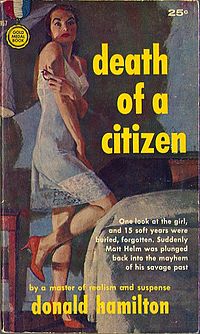
matthelmVague memories of a Matt Helm movie as played by Dean Martin or some square-jawed male star from the Sixties. If I recall, the film was sexist and dimwitted. Maybe my memory fails. Maybe it was a TV thing, not sure.

Hamilton’s books are sure to be better.

Donald Hamilton was a good writer. A journeyman and a pro. A WWII vet. Started his paperback writing with Westerns, as did Elmore Leonard.

This novel in the Helm series (often recommended as the best one) doesn’t exactly start with a sizzling pace. Several chapters in, everyone is still hanging around the same dinner party that began the book.  The narrative voice is first person repetitive, sometimes overstated.  It came with the times. Back then, commercial writers made sure everyone got it.

But as the beginning dragged on, I wondered: Have things always been so damned exciting in New Mexico?

Not all is torpid. The descriptions of the “secret organization” are entertaining. You know, that secret organization to which Helm and the pretty gal in the black dress at the party are committed. This is the pretty gal who he just happens to encounter after all those years and who he had big espionage adventures and a roll in the hay with and who now taunts him with her beauty and darting eyes right in front of his wife.  And there are engaging scenes between man and wife. One notable moment occurs when the narrator’s description of how, in general, a lady always looks better after a party when she’s a bit worn out. This is about the extent of the suspenseful action in the opening fifty pages — until a woman (the citizen we assume) is found dead in Helms’ place, and he is set up. 

“The Deep Blue Good-by”: John D. MacDonald

deepbluegoodbye“It’s right up your alley,” the pretty coworker said when she gave me a book, twenty years ago.

What color it was I don’t recall; it wasn’t the deep blue one shown here- maybe it was lime green or yellow. I do remember that the author was John D. MacDonald, and it was a Florida book, mainstream variety. It sat in my bookcase a few years and eventually found its way into the donation bag, unread. My mistake.

After the recent rigor of reading “The Flame Throwers” and other literati books, this is now the reading summer that includes so-called Middle-Grade fiction. Within that is the school of the Hardboiled. I chose Travis McGee as my first hero to read. He’s not a cop and not a private eye nor secret agent. He’s a “salvage consultant,” after the money and the adventure.

I started with first novel of the series. There’s a ton of great stuff, informal real world stuff packed inside, a fair share of it artful description by Trav about himself. The stuff is woven into a simple story of increasing tension featuring one helluva bad guy named Junior Allen. There are Lauderdale dock hounds and various hucksters and drunks. And girls and women. Plenty of women, from South Florida tourist girl bimbos, to yacht candy gals, to a sensible wise friend and dancer type, to victimized trailer park honeys, burger joint waitresses, alkies, and beyond.

The most important female in the book , as it turns out, is Patty Devlan, the young innocente who McGee saves, rescuing her with her virtue in tact. But this is not the girl he gets. She’s way too young. She is solely representative of his moral imperative. He was falling for another one, and she…well, that would tell too much.

McGee is an opinionated narrator, often buttressing his descriptions of people and actions with micro-essays about macro topics. The guy could really use space. He could tell a thousand words in a few hundred. MacDonald wraps in trips to the Texas Rio Valley and to New York, both of which would induce chapters of considerable length from us mortal writers. But MacDonald can give us the Rio Valley in two pages or so. We’re there. He became my kindred spirit. I’ve been to that area and tried to write it numerous times. His depiction is brief, redolent and spot-on.

The novel runs about 300 pages and is loaded with terrific writing. Of the pulp authors I’ve read (and I admire Chandler most) MacDonald’s the consummate professional writer and the most honest one. A detail guy, and an astute observer.

As of last week there’s a bottle of Boodles Gin on the bar table. I’m going to read a few more McGee’s before the summer’s over.  If I had only paid attention to my friend at work…