booknotes

Salinger’s Boxed Set

salingerRumor columns say the Salinger estate will release additional works, some of which supposedly pick up characters of yore and take them forward in time. True? Who knows for sure other than a few lawyers?
Meanwhile, I’ve stashed the old and supposedly rare 1969 moldy, pot-smoked, yellow-page boxed set and am replacing it with clean copies. It was time.

If there are new JDS releases. I’ll be ready.  This summer, I’m revisiting the Glass family and Holden and DeDaumier-Smith and Teddy and all the others.   (to be continued)

((())) seymour bouquet of parentheses

JAMES SALTER’S “A SPORT AND A PASTIME”

SALTER It’s bad practice to post a brief book report after reading a few reviews on Amazon, at least in my own writer guidelines. But this time, I did just that. The uneasy sense of confusion I had while reading this Salter book was too much. I rapidly went in search of confirmation. I found that others had similar reactions. One reviewer said it best, that Slater gives us an engaging intelligent narrator in a lovely setting in France and then tosses a monkey wrench into the telling.

In a klunky way, Salter puts his narrator in the role of describing some other guy’s romance.  We sense an odd attraction between the two men. Why, we aren’t sure. This is far from Nick and Gatsby, or that type of clearly executed observer voice. This is an odd hybrid of first POV and third POV. Much of it is unknowable by the first person voice, yet documented in vivid scenes. Since he’s not present, it is impossible for him to document the episodic sex scenes between his friend Dean and this Ann chick. So the narrator says, well, I’m sort of imagining it.  Huh?

There’s plenty of flesh. The book was written in the Sixties (1967) when womens’ rights awareness wasn’t yet raised to the height of the 70s. Still, there is a lot of room for feminist complaint about the objectification of a woman, i.e., Ann being a mindless sperm receptacle, etc. Fact is, Dean is pretty shallow too. Maybe in that sense he is a harbinger of men characters in future women’s novels. The ones in which women’s characters are duly given full development but at the cost (intentional or not) of shallow portrayal of the male characters. In a sort of role reversal the male characters end up as sex objects themselves, like mindless and faceless hard-ons.

This book has been touted as a “writers’ kind of writing” novel, a sort of paragon of styles and language. The writing itself is very good.  Slater has a refined style and immense talent with words. Stretches of it were so well written I went into a reader’s trance. But overall I didn’t like the story and characters and found the novel difficult to digest.

Ben Hogan’s Five Lessons, by Herbert Warren Wind

hoganWhat’s a golf book doing among the rest of these literary books? Because it has stylized, lofty, quirky writing. It’s the most interesting and entertaining book about how to swing a golf club that I ever read.

Herbert Warren Wind was a sportswriter, of golf primarily. He wrote for Sports Illustrated a while and for The New Yorker for several decades. He lived to nearly 90 and died in 2005. The Hogan book came out in 1957.

It is the most famous golf instruction book ever produced. Many golf books after it are repackaged derivatives. The language is formal and wordy and over-wrought. Half Eisenhower didactic and half Victorian ornate. The info is still there.

Hogan said he actually meant to understate his golf tips and allow the readers to study and learn by implication. The aha! moments would make them better golfers.  The dense eloquence of Wind’s stern and repetitive instructions makes this difficult. But the advice is there, ready to be mined and refined. There are subtleties if one looks for them. The expert drawings by Tony Ravielli help make the book succeed.

Some examples of Wind’s eccentric writing style (based on Hogan’s SME input, of course):

“It may seem that we have gone into unwarranted detail about the elements of the correct grip. This is anything but the case. Too often golfers mistake the generality for the detail.”

“While it is dynamically important for a golfer not to depart from his plane at any time during the second part of his swing, being consciously attentive to it does not help him the way a consciousness of his backswing plane promotes a fine, functional backswing.”

“Interestingly enough, drinking some ginger ale, because of its effect on the kidneys, seems to prevent the hands from feeling too fat and puffy.”

“Consciously trying to control the face of the club at impact is folly. You cannot time such a delicate and devillish thing.”

“Don’t groove your waggles.”


Raymond Chandler – Selected Anthology

raymond-chandler-later-novels-other-writings-lady-in-hardcover-cover-artVenerable black-cover anthology from Library of America. I’m not much on detective stories and mysteries and have a low threshold. I always return to it because Chandler was such a terrific writer.

I keep going back to read “Red Wind.” Not for the story as much as Chandler’s writing style, especially in the opening scene.  As with most of Chandler’s stuff, there are clever, memorable lines and a succinct presentation of California ambience surrounding the characters.

Some of Chandler’s narrative tone can sound dated now, co-opted and twisted by years of TV detective shows and b-grade movies. Chandler is much better than that sort of tough-guy stuff. He was an artist, not merely someone who produced pot boilers. The guy could crank out great sentences and imagery. His narrative talent is legend among California’s struggling writer types, so a West Coast correspondent informed me. Chandler is someone to emulate on the path to a movie script.

Of the shorter pieces in the collection, I think the best is “Spanish Blood.” It has all the right ingredients of a short story and is more straight-ahead and satisfying.  It’s not so puzzling and convoluted like the majority of mystery stories tend to be.

Ben Lerner’s “Leaving the Atocha Station”

lernerIt’s a druggy and brooding account of a young man’s experiences abroad. Our narrator in Madrid is an insecure poetry scholar away from home with an at&t calling card and an unease about his conversational Spanish abilities. He’s also a pothead, as evidenced in his vivid and introspective descriptions of getting high in strange places and vice versa. A trick in parts of the storytelling is the narrator’s concern about language, which enables him to zig-zag and restate phrases as if trying to interpret the Spanish and present the possibilities of what he hears in English. So there is wiggle room in stating things with precision, a circumstance that suits our intelligent but often stoned-out and shy narrator. As the novel progresses we see he is much better at communicating than he himself believes.

Lerner’s prose can sparkle.  For example he has a nice description of the nights typical to many tourists and Madrileños: sidewalks where there is the endless racket of plates and silverware on metal cafe tables, a constant thrumming of traffic, and couples meeting as the city comes alive late at night. The revelers go from bar to bar then to disco then to make-out sessions. At night’s end they share an iced chocolate before going home. The narrator describes the smell of Madrid as “wet stone.”

I’m prejudiced as far as finding keen interest this book. I was a student in Spain long ago myself. Doing drugs at that time (before the country was Westernized and still under Franco’s Guardia Civil grip) was not as prevalent and also very risky business. One of Lermer’s scenes presents a woman who makes gin and tonics “as a Spaniard would,” with a glass of ice filled with gin and a mere splash of mixer. That sounds more like the Spain I visited.

His prose can also nail the elusive aspects and feelings of a relationship, especially when one party (our lead character and narrator) is less than truthful. In fact he makes up some whoppers: dead mom, fascist dad, he’s rich, etc. As the story gets deeper, he has to contend with his own lies. In a terrific stretch of writing he compensates by acting out another lie. Unable to afford it, he takes a girl to an exclusive restaurant and buys everything in sight, then beds with her in a pricey room at the Ritz Hotel. All of the damage is run up on his parents’ credit card. Meanwhile, terrorists have blown apart a train at the Atocha station, and as a result protests are occurring throughout Madrid.  While his friends and love interest are participating activists, he is on the sidelines, a self-absorbed lump. He fails romantically with two extraordinarily patient and adorable Spanish women. You want to shake him. His poems are his only grace.

“Reminiscences of a Stock Operator” by Edwin LeFevre

Reminiscences_of_a_Stock_OperatorI’ve found no stock trading book as fun to read as this one. Cramer’s first Mad Money book is the only one I’d rate as even partially enjoyable. This one happens to be 100% enjoyable. It’s a novel, a memoir, incidentally a manual, and a bit of philosophy all rolled into one. The narrator is Livingston, a boyhood wonder with a keen memory for figures and an intuitive eye for fluctuations. His career tale is about boom and bust, reputation and ostracism, the constant ups and downs, the cycle of repeats and his need to secure and then raise the stakes. The author LeFevre presents the stock operator’s account in a conversational 1st person voice that is likeable and durable.

This book was written in 1923. Of course the technology and forecasting game has been vastly affected by computer technology, but many of the fundamental rules of playing the market remain the same. The novel presents advice in the context of the story. For example:

“…after making and losing millions of dollars I want to tell you this: It was never my thinking that made the big money for me. It was always my sitting. Got that? My sitting tight!”

It’s a fine novel with an interesting story, even without the aspects of being a lesson book in Market wisdom and attitude. It demonstrates by action as much as it tells. Livingston believes there is nothing the stock market hasn’t already experienced. It’s up to a trader/investor to read the signs and take some risks in order to be a profitable player. The reader will need to be willing to extrapolate in time and find the underlying market dynamics and psychology of traders as applied to Now. This story can make you want to lay out a stake, open a wildcat portfolio, and play the ticker with a Zen sort of knowing recklessness.

Proust “Swann’s Way” & Other Books: Fall Blogarama Complete

marcelp

A great read, though there were plenty of parts I skimmed.  A Proust initiate’s reactions so far….Streaming syntactical parades loaded with the narrator’s sentiment. Dozens of sensory images. The first section involves the recollections of his sleeplessness as a boy, and his persistent attachment to his mother in order to sleep. Raised rich and privileged, boy Marcel’s stuck in his bedroom with a sort of childhood Brian Wilson syndrome. There are lots of food smells and tastes and lots of plants meticulously described. Of course the big deal is the infamous memory-provoking madeleine cake with tea made by the house cook-servant Francoise (cf. old theme of hired help and the dominant power thereof). When boy Marcel turns to fiction, Proust includes some interesting digressions about novels. The comments are erudite and expressed by the author. On returning more specifically to boy Marcel, the author describes the unaffected joy of reading books in one’s youth. It’s Part I in Combray. Towards section’s end, about 150 pages deep, the writing picks up pace and is more engaging. Our narrator has emerged and is an observer of the people around him now, outside his bedroom. There is a lot of content about Legrandin who is emblematic of  effeminate and pompous bores. Proust may have set him there to make the appearance of  Swann look even better by contrast.  The young narrator (I imagine him now as being ten to twelve) expands his horizons and takes long walks away from his aunt Leonie’s property. We learn that there are two walking routes, one of which is the more scenic and interesting – “Swann’s Way.”  As he roams, he begins to think of nymphs and women’s bodies.  He meets a love object, the strawberry blond daughter of Swann, Gilberte.  Mlle Swann is contemptuous of  him at this point and gives him an obscene Paris street gesture (which begs for research).  Further firing the adolescent fantasies of our narrator is the by-chance sighting of Mlle Viileul meeting with her lesbian lover. Strong stuff for a novel dating back so far.  But this is the rich and luxuriant canvas Proust paints of decadent bourgeois France.  Near the end of Part 1 we see young Marcel the narrator present us with his first serious attempt at writing, the famous “Three Steeples” scene.  When Part 1 ends, he is awakened by the rosy finger of dawn (right out of Homer), and the Combray section ends as if it had been a long night’s sleep ever since the insomnia and Mom’s kiss and the smells of tea and madeleine. Apparently, M. Swann himself has a bad rap for marrying beneath his station to the demimonde Odette, and this is the central story of Marcel’s more omniscient voice narrating Part 2.

At this point, before starting “Swann in Love,” I turned back pages to read the intro by the translator Lydia Davis. It confirmed some things — it let me know I was getting it. My reading had not been that haphazard.  Proust is very readable. Brilliant and digressing, with layers of symbology (e.g. plants and flowers, hawthorn for one). At times I skim over passages of the narrator’s vagaries, then a section comes along that pins me word by word to the pages. Davis says to be patient. Everyone has a different reaction to the book. But I’d say anyone who has not read at least 200 pages deep would never understand her intro, much less what Proust is gifting us with.

In Part 2, the superficial relationship between Swann the Dope and Odette the Sponge is grating my nerves. The pretentiously unpretentious circle of friends has set the chapter’s tone, which is flippant and slightly sour. Proust goes metafictional or at least self-author-referential in one passage that describes how one character in the inner circle (the artist) is such a talker and can go on and on and riff on any topic. Really? Meanwhile, the Verdurin crowd’s patience is wearing thin with the Teflon nature of M. Swann who is dodgy and attends not to join the group as a kindred soul but only to play his absurdly transparent love games with Odette. The group sees her as a shapely bundle and a male agitator, and Swann as a stick man with no point of view, and both as lacking keen wit or conversational vigor. We’re told rich Swann’s funds are sinking low as he pays out to “keep” her.  It is not clear if he is fucking her, but he is johnny-on-the-spot to both appease and manipulate her. When she goes her own way he falls apart at the seams and sinks into a juvenile state of insecure curiosity and exaggerated concern over losing her. It’s pathetic, of course, but the beauty is in Proust’s command of words to depict Swann’s sorry condition. The section title is now dripping with irony. Swann is in love only with the game of behaving like he’s in love. The reader soon sees Swann’s “cattleya” goo-goo sexual approach and his piano sonata heart-throbbing …all of it is pathos. It remains to be seen how this unfolds. Or crashes. Meanwhile M. Swann is losing ground as Odette has her way with him and keeps him at a distance. The original “I” narrator vanished in Part 2 and became 3rd person narrative god (little Charles/Marcel becomes author Marcel Proust).  In the last part of the novel, the “I” voice returns. Young Marcel seems still pre-teen though it isn’t specified, and is a reflection of Swann who he admires and emulates. He develops the same sort of fawning lovesick behavior towards his daughter Gilberte, who in turn is a reflection of her mother Odette (an unhappy surprise…Swann married her) by way of her aloof and cold disdain for the affections of boy Marcel. There is an implication he also has a thing for Odette and can sense her allure even at his early age. These will be topics in Proust’s second volume, In the Shadows of Young Girls in Flower. Not sure I’ll ever go there, but this first volume turned on the lights about a famous writer and the works that I have avoided and kept in the dark for years. A fine revelation and worth the reading effort.

SIDEKICKS  (novels also stacked by bedside for longterm reading, and only parts have been read so far. Maybe will split out into their own reports later)

mutfriendOur Mutual Friend,” Dickens’ last novel. Dark. More oblique and complex than his name novels. Opens at night with rival boats dragging for a body in the river. Gritty characterization of people in London the poor family kids, the dust heap hustlers, the wealthy consumer-conformists, greedy counselors and venal inheritance seekers, strange street dudes and informational posers of all varieties. Not far in, we get  Twemlow the human furniture piece and the funny Veneerings who are as superficial as their name sounds. lonesomedove

Lonesome Dove,”  McMurtry’s writing in this one is like rodeo-talk mixed with the campy voice of “Dodge Ram tough.” Events can sometimes be absolutely trifling. But when the author shifts to events of more substance the writing comes with an accomplished ease. McMurtry’s material can be both banal and sublime, but he is always skilled and literate. There is no short-changing. He gives us honest prose. Enormous writing energy is required to create scene after scene over 700 pages, weaving the motives and desires of characters, making them vivid, and placing them in a setting and milieu that we can see and experience. Larry Mc is getting up there now. What a treasure he has been over the years in American fiction. fandj

“Fortunata y Jacinta,” a novel studied in part when a Spanish language student many years ago. My professor hauled me along to an academic seminar at Mary Washington College. A series of speakers read esoteric papers about Benito Perez Galdos. I learned he was long since dead.  A strange osmosis took place. My Florida novel has two Spanish-speaking sisters as characters, who I named after Galdos’s dos casadas. Full report on this great novel when I’ve time to read it all, maybe next year.

SHORT SUMMER VISIT With SARTRE’s FICTION

Maybe we innately know what “existential” means and have even lived it, and can recognize its flavor and themes in works of fiction. Yet it’s not easy to have an on-the-ready, cogent definition. Reading Sartre’s fiction pieces did not, unfortunately, help me come up with one.

I did admire the stark writing and wandering investigations into the meaning of reality. As in Camus, hefty ideas are conveyed by scenes that provoke layered, individually selective (or random) reactions.

There is helpful information in the scholarly prefaces to Sartre’s stories. It’s a philosophy, after all. And one that concerns meaninglessness and superfluity. What the hell, it’s all madness, so how do we proceed sort of stuff.

My friend Tom Weathers has a scene in his novel Redux where two characters discuss its meaning over a meal. It’s as handy as anything I’ve read:

“…in the modern books that I read, I keep running across existentialism – you know, the French thing.” He looked at me to see if I knew what he was talking about.

I ate my last piece of pork chop. Pointing with my fork at his plate which he hadn’t touched, I said, “Yeah I know what existentialism is. But if you’re going to stay here it’s going to cost you. I want your pork chop.”

“Sure. OK.” He slid his tray and plate in my direction. “The thing is, none of the explanations that I read make sense. What does it mean, existence precedes essence? Everybody just assumes you know what they are talking about – but I don’t. It seems important, like if I don’t know this then I won’t know the rest, you know what I mean?”

He looked at me. I nodded and ate his pork chop.

“So can you tell me?”

“What existentialism means?”

“Yes.” He really seemed desperate.

I paused, knowing that I would sound pompous. “It means there is no built-in meaning to anything. There is no God-given truth. It all comes from you, from your own miserable little existence. You make your own truth.”

© Tom Weathers, “Redux” 2009.

wall

Nausea is a novel. The main character is a writer who is conflicted and unhappy. He experiences physical nausea over his heightened sense of the futility of things. He has unusual friends like Self Taught Man who acts as a sounding board for ideas, and also a female interest named Anny.

The Wall is a collection of five short stories.  Some are straight-forward and amusing, some dark and dense. “Intimacy” was my favorite. It is about relationships and arbitrary preferences. The title story (Le Mur) is about a prisoner’s fate. There is random meaninglessness in the character’s avoidance of execution and the doom of another.

-wpm

Carver’s “What We Talk About” Stories

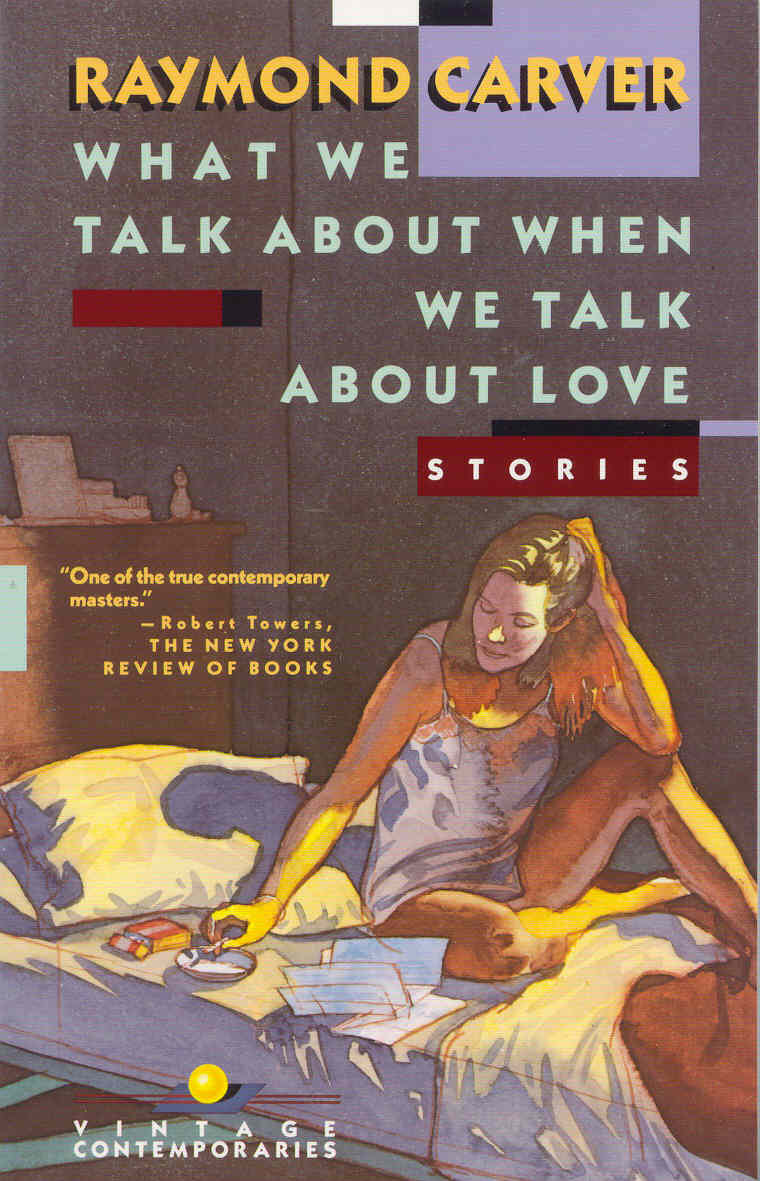
carverIt’s superstitious, but for fear of disappointment I don’t want to read another Carver collection. This one, which I like to re-read every year, is totally satisfying.  What other Carver book can match up?  What’ll it give me extra? Like ordering two filet mignons, well maybe, or dessert and more wine but why?

This is the style and tenor that launched hundreds of national writing classes and made Carver the number one honcho at U. Iowa Workshop. Among its many attributes, the book is instructive, even to those of us who’ve been writing for decades. To some, the prose is too lean on the bone. It is and it isn’t. It defines the fat without having to add it.

Carver was famous, a Jim Morrison of the short story revolution.  He wrote in an economy and impact unseen in fifty years since the salad days of Hemingway in Paris. Carver knew about Papa’s iceberg theory and the power of omission.

I don’t know what else to say. Other than, if you write you should read and study this. Put in on your top shelf with Joyce’s “Dubliners” and Hem’s “Complete Stories.”  Bring in another modern and post-modern or two for balance: maybe the Barthelme’s, or Jennifer Egan, Joy Williams, or the highly underrated Richard Brautigan or good ole Elmore Leonard. The Carver book teaches writing and reading and inspires both.

“A Hall of Mirrors” by Robert Stone

stoneIt’s a Sixties novel written in unadorned, straight-ahead prose.  The style is in the school of Hemingway, with flavors of Uris and Mailer, Ruark and O’Hara. Like the kind of gritty novel that used to bring men and their sons into a mid-century newsstand’s paperback section, where they could get books for less than a buck. Those days are long gone, so for me there’s an element of nostalgia in reading this novel ( from 1964). It reminds me of being a teenager in simple summertimes when multimedia distractions didn’t exist, and there we were with just a book, reading into the late hours, totally bought in, unable to put it down.

The characters include alkies and scarred women, hucksters and dangerous zealots. It’s a New Orleans of political crackpots and attendant injustices, as things purportedly were in that Oswald era.  The principle characters Rheinhart and his woman Geraldine are two drifters who end up in the Big Easy and happen to meet at a fascist-styled work factory. Their modus operandi is to do most anything to keep a roof overhead and survive.

Karen Russell’s “Swamplandia”

swamplandiaAt surface level, the story is entertaining. At another level, it’s visionary and mythic. The book takes place in the Everglades and at times seems mucky and absurd with all the gator show stuff.  Then again, after some reading patience, we see that the setting is transcendent, almost like a surreal Macondo village for one small family. At times the environment is genuinely fearsome, a primordial, superstitious land, a veritable hell-hole haunted by the horrors of Indian history and misguided development.

Russell knows her writing and her novel places us in various levels of reader reaction. It’s a book with well thought-out structure and theme. Various chapters were short stories brought to a united whole. She can cut a phrase and put forth detailed images that nail a setting and create a mood.  They are almost too good, the visual details. One wonders, how long (in a cynical, nihilistic, often numb reader nation, and in terms of literary modes and fickleness for “what works”and what is durable for artistic perpetuity) can such a delicate level of imagistic writing remain as paragon?

Russell brings us along, making the many digressions interesting, and meanwhile subtly getting us to care about the Bigtree family circle.  Then we get into Ossie’s call of the sexual wild and Kiwi’s dire employment at an apocalyptic theme park. When Kiwi leaves home, the chapters alternate between Ava’s 1st person narrative and third person limited for Kiwi.  It’s not orthodox, but it works.

At one point less than half in, I was dismayed and about to set the whole damn business aside for later.   But then came the growing mystery of the dredging boat and Louis and Ossie’s disappearance…then the author brings in a larger than life character, the mystical Bird Man who with  his quiet voice of accommodation becomes Ava’s apparent hero (though he’s far from it). They go on a supposed quest to find the wayward sister and head for a remote area in the marsh called the Underground. Along the way, Ava is confronted by reality versus illusion.  Is It Real or Not?  Is it Paradise or a Land of Buzzards?  Can someone like Mama Weeds really exist out there?

In dramatic parallel we get alternating chapters depicting Kiwi’s misadventures at a macabre theme park over on “the Mainland,” where life is anathema to the Bigtrees. As he works his way up the employment chain from park maintenance to lifeguard (and hero) and eventually seaplane pilot (again a hero), we realize the coming convergence of the two storylines.  All’s well that ends well. Their native home and its sustaining Alligator Wrestling Show does not survive “Carnival Darwinism.” Mainland life wins in the end. The sisters leave their aboriginal culture and have to march in line with the rest of the Mainlanders, wearing uniforms at school with white girls.

It’s tricky to tell where this story is located. Best I can tell, it’s fictionalized to the point where there’s no need to say, but real geographic names and areas (rivers) and landmarks (I-95?) both far and near are mentioned.  The swamp seems to range anywhere between Punta Gorda and Flamingo ( a lot of miles).

Donna Tartt’s “The Goldfinch” Blog-a-Rama

donna_BBCPhoto

photo by BBC

The Beginning 

The hardbound book’s impeccable packaging invites us and signals quality.

The novel’s opening pages with their lengthy lyrical sentences give a powerful impression that we’re in for something special.  Something in the heavyweight league. The exquisite use of language and pace makes me think about how remarkable the audio version of this book would sound.

At the onset we get a vivid description of the narrator’s hotel hideout room and a strong sense of his desolation beside one of Amsterdam’s green canals.  What is his source of despair?  Of course, we also wonder what’s the controversy outside and why he is avoiding it.  Meanwhile the narrator, perhaps because of his solitary situation and the excess of lukewarm vodka, is overcome with thoughts of his mother, who is depicted in stunning consecutive sentences that detail her appearance and demeanor. Then we learn how he lost her and the underlying story launches.

The tired writing rule that one or two character particularities goes a long way, and another rule that exposition interferes with dramatic scene …both are about to be blown to bits by Donna Tartt’s talent.

Part I  

What we have in the book’s opening act is the initial storyline patiently presented, along with a rich startup array of interesting characters, major and minor — though this early in the book it’s impossible to say which are merely minor. Some reappear after the explosion, like Pippa, who Tartt (during her amazing bomb description) telegraphed that we were likely to see again.  Some reappear as dead people memories. Others, including the artfully portrayed Harbour family, and guys like Cable and Hobie…we’ll see how far they go.

It’s interesting to note that any shrinks, educational overseers, or investigators etc. assigned by the state to check on Theo’s welfare are unfavorably described, which is consistent with Theo’s silent disdain towards them. Despite best efforts by the magnanimous (and filthy rich) Mrs. Harbour, her good-humored husband and polite son Andy, Theo is withdrawn and sealed up until he finds Hobie. The return of Welty’s ring to a living connection authenticates Theo’s memory and, adding in the reunion with Pippa (all of this in the “Morphine Lollipop” chapter), his existence takes on a new, more hopeful light.

Tartt, an admitted fan of Dickens, is (so far anyway) doing the Copperfield/Twist/Pip bit: placing a young man in a dire and/or peculiar situation and bringing us along with him as he navigates and grows up. His path is strewn with tragedy and loneliness and a barrage of strangers and renewed acquaintances who assist or hinder his path forward. The big difference is Theo is an American boy in 21st century Manhattan.

Donna Tartt is masterful in these early chapters, unfolding the story in a way in which we are attentive to and empathetic with the new orphan Theo. When we quit reading and turn off the light, the concern for him remains. Others are interesting too, and we want to see them again.  That is, the book is beginning to own us.

Parts II & III  

The contrast between Park Avenue and Vegas is a shock to Theo and to us too. Tartt conveys the stark differences with humor, sharp details, and shredding imagery.  We recognize Vegas’s cheesiness and plastic quality, and the tackiness of his father’s home is signaled right away by the faux elegant name of their cookie-cutter development, presented by the author in faux elegant font: The Shadows in the Canyons.

Theo’s father is a drunk and a bad gambler, and his girlfriend Xandra is a thief and a loser. The contrast in style and behavior to the graciousness of the Harbours is staggering. Our only consolation at this point is that Theo managed to get the painting out of NYC and has it there with him.

It’s really clever that when Theo left, the Park Avenue doormen were his support group. They too mourn the loss of Mrs. Decker and are Theo’s close allies. Theo cleverly speaks Spanish to them. One, the Puerto Rican, says he misses the warm weather and is a “tropical bird.”  Which plays on the painting that the doormen hold in a suitcase for pickup by Theo (which he later unwraps in his colorless Vegas room and sees as contrasting bright and rich — tropical).

Boris’s supposed exploits are excessive and his Ukraine talk is over the top, but sometimes fiction asks us to suspend our doubts and go with things.  Plot-wise he’s functional …(so far –I cant speak for the pages ahead) … functional as the worldly influence kid, an entertaining ingredient in Theo’s coming of age. Does the movie title “Iceberg SOS” foreshadow anything?

Classic scene: Dad’s compensatory holiday dinner at the extravagant restaurant on the Strip. We see more of America’s greed and misplaced values through the eyes of Theo and the Russian Boris, in particular.

The thought came to mind, how does Tartt manage to capture the lives of teenage boys so well?  Maybe she took their three main activities and took off from there: fighting, getting drunk or high, and obsessing on girls.  That’s what Theo and Boris are into. Boris, however, brings more criminal mischief, some homo-erotic closeness, and his own domestic traumas that he tries to disguise. He exudes an overall sense of unreliability and danger, not unlike his bipolar dad.

Odds and ends in Tartt’s Parts II & III tapestry:

  • Climate change. she brings in vivid yet understated descriptions of the erratic weather out West.
  • The economy: the mostly empty and unfinished neighborhood (Canyon Shadows) depicts the fall of housing and death of the boom (Bush Recession) in the expanded exurbia of Las Vegas.
  • Modern Girls into Renunciation: Kotyu.
  • Drug excess: the boys take everything except heroin and drink vodka straight from the bottle.
  • Modern wake: Xandra and her loose pals getting totally messed up
  • Nineteenth century novel type journey: Theo’s bus ride back East with a tiny dog in a box w/crusty yet charitable driver
  • Replacement of cozy old building of value with a new and overpriced greed palace

Part IV 

Past midway, it’s the biggest time jump in the book so far: eight years later.  Could be a moment in the narration to be reflective and have the story decelerate, but Tartt doesn’t go there. She keeps rolling out surprises and moves relentlessly ahead with event after event to keep us engaged. It’s true, though: this series of chapters has a lot of packed tight exposition. But it’s interesting exposition.

So far, the section is loaded with loss: people who are dead, gone, or are not themselves anymore. Pippa has a boyfriend, which makes Theo crazy. The old homestead is gone, the Harbours are shattered, and Boris is still en absentia. There are  problems brewing at Hobie’s shop and some less than honest dealings have put our protagonist in a difficult spot.

Theo falls heavier into drug use. He is threatened by the sharper Lucius, who has figured things out. The story jumps again, and Theo is engaged to the vapid Kitsey, and they shop for china patterns.  We think, here we go again, Theo has stepped into a mess and seems to make it more of one.  He is now less favorable a character to us (our sympathetic mood changes, that is) because he has money and free will and keeps getting in his own way, making mistakes that cause us to want to shake him.

Things look foreboding as he runs into Boris, and they proceed to some heavy vodka drinking in the Village…

Part V 

Theo’s dark descent into despair appears to be over. Theo’s world is momentarily stabilized by his engagement to Kitsey, a relationship cultivated by her mother, Mrs. Harbour.  Not all is as it appears. Again, Theo is in and out of other people’s hands, blown around by circumstance, his fate coming through no real control of his own. This is best demonstrated in the engagement party where he is a role player but not a person, entangled in a high risk situation. Only in the prior scene, during his movie and dinner with Pippa, do we get to see him truly as the Theo he would want to be…and what he is capable of feeling for another. Yet even making small decisions is something he finds difficult. He is sitting on the fence now, romantically, as if his other problems weren’t compound enough, and his judgment is clouded by long drinking and drug sessions.

Boris eventually brings him into the big league world of art theft and thuggery. He takes him into his world of crime and paybacks, whisks him away from the Kitsey situation, and puts him to use overseas.

Their mission to regain the Goldfinch takes the book out of the milieu of a New York love and adventure story and into a drama of international detective-like shoot-em-ups, replete with criminal desperadoes and a lone witness who spoils everything.  But it works out…the very beginning put us smack into intrigue, so we knew the loop would come around again….

Theo is stranded in a hotel without a passport, and his darkness returns…things rush to a conclusion, yet there are a wealth of epiphanies and reflections at the end…

(NOTE:  Will post the last report after I let everything settle -wpm)