I read it in the 1970s and decided earlier this summer to go back and revisit. Mellowed in most all my habits by now, I took my time and relished the clarity and beauty in Kerouac’s prose. This time I better recognized his visions, and appreciated his sharp reporter’s eye for life on the streets among the poor and artistic and the beat – and the pretenders too, in America and in Algiers or Mexico or Paris. His views are amazingly prophetic, inserted unobtrusively, on social and environmental conditions as well as cultural strata and public attitudes.
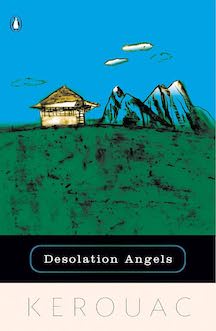
This book is more meditative and patiently presented than “On the Road,” where constant acceleration urges the narrative forward. “Desolation Angels” is less screenplay-like and more a spiritual testimony. It’s by far my favorite of all his books.
Kerouac details his life journey in the year 1957. A hundred pages in, I had to remind myself that it is not a work of fiction but autobiographical, or what some today call “autofiction.” A full list of the corresponding real-life names of the characters is commonly available in roster form on any article that thoroughly examines the book. Yet, it’s a small matter where it belongs on an academic chart of genres and sub-genres. The writing is so entertaining and soulful, and the imagery and themes so rich and resonant that the book crosses over into the land of literary fiction and certainly merits being there.
Kerouac based the structure and Parts on changes in location, starting with his solitude working a summer in a national park fire tower, and concluding with his return to be with Memére at her simple haven in Florida. In between, he meets up and shares adventures with a vast cast of fellow poets and writers, the Beats.
He has gone from lonely, spartan living in the mountain tower to sleeping bags under the stars to shared apartment crowds to the womb at Mom’s house. We think his account ends in Florida, but it doesn’t. Kerouac is too restless. The book reaches its finale with his rapid exodus back to Mexico City only to find his friend Gaines has died. He travels to New York where he and his striving writer-poet friends gather and consider their new status as known, published authors. As with many a hero’s journey, the story leaves the suggestion that the quest is often more rewarding than the realization of obtainment.
 williampelotmoore.com